Home » Articles posted by ozarkmountainhiker (Page 11)
Author Archives: ozarkmountainhiker
Unlearning
Sometimes what you know can hurt you. During a wilderness first aid course I recently completed, the instructors spent a fair amount of class time debunking ineffective first aid actions and replacing them with evidence based actions and protocols. Many of my assumptions about first aid were wrong and I had a lot of unlearning to do.
The trainers had a habit of saying, “The body counts are in and that’s no longer the right way to treat that emergency.” In other words, new evidence suggests new practices. Will we learn from the evidence and change our practice or continue to do what has been shown not to work? Will the victim of an emergency be helped by our involvement or will we make things worse?
My first session in the Leadership Academy Principals’ Institute was all about unlearning. I’d entered the principalship with some misconceptions about what was important in school leadership. I was overwhelmed when faced with all that I needed to unlearn! This was a painful and sometimes embarrassing process. I describe the leader I was back then by saying, “He looked and acted like a principal. Folks liked him and he cared about the kids but he wasn’t anywhere close to being what the teachers and students needed.” This was hard to admit, but that admission was necessary before growth and new learning could occur.
In last month’s AAEA newsletter, Dr. Abernathy challenged us to think outside of the box and apply for waivers to enable us to implement new and different approaches to helping our students. He challenged us to look at barriers to innovation and apply to have those barriers removed.
As I began to work with teachers on this I found that I needed to unlearn ways of thinking that have become automatic over the last few years. We’ve always said, “We can’t consider looping classes from fourth to fifth grade because of certification issues.” But now the question to ask is, “Why not?” It took effort to suspend judgment long enough to let an idea float for a moment without moving immediately to constraints of present rules, time, or money. As we worked together, we found several innovations that didn’t even require waivers. Thinking in terms of “what if” and “why not” allowed those ideas to present themselves and we look forward to continuing this process.
A great educational leader speaking to our staff a couple of years ago said, “You would be appalled to learn how some children are treated right here in our own state.” Part of what he meant was that some adults who should care the most about children are harsh and cruel in their interactions. He was also referring to poor treatment in the form of ineffective instruction. Evidence has shown that certain teaching methods are ineffective yet we often see these practices continuing. Being stuck in a classroom under an ineffective teacher is the ultimate in cruelty. If the “body counts” are in and the evidence shows that a practice is ineffective, it’s time to make a change!
Changing what we do with students at the point of delivery in the classroom is difficult. Changing teaching practices requires a willingness to unlearn and a deliberate effort to do something in a new way. There will be costs in time, money, and emotions, but the rewards for persistence are great.

When we’re moving toward more effective practices and feel pushback, we must be relentless and keep plugging away. We can work with early adopters and the big middle of our staff to move forward, giving resistors limited attention. If we provide the conditions for change and allow teachers to gain the necessary learning, we’ll reach a tipping point and see acceleration in positive change.
During classroom walkthroughs recently, I enjoyed seeing the results of a challenging change we made in teaching practices over the last four years. If I tried to take teachers back to their previous ways of instruction in this area, they’d run me out of the building, and rightly so. I realized that the change was real and now part of how we do things. Making this change was hard but seeing the benefits to children and adults is rewarding.
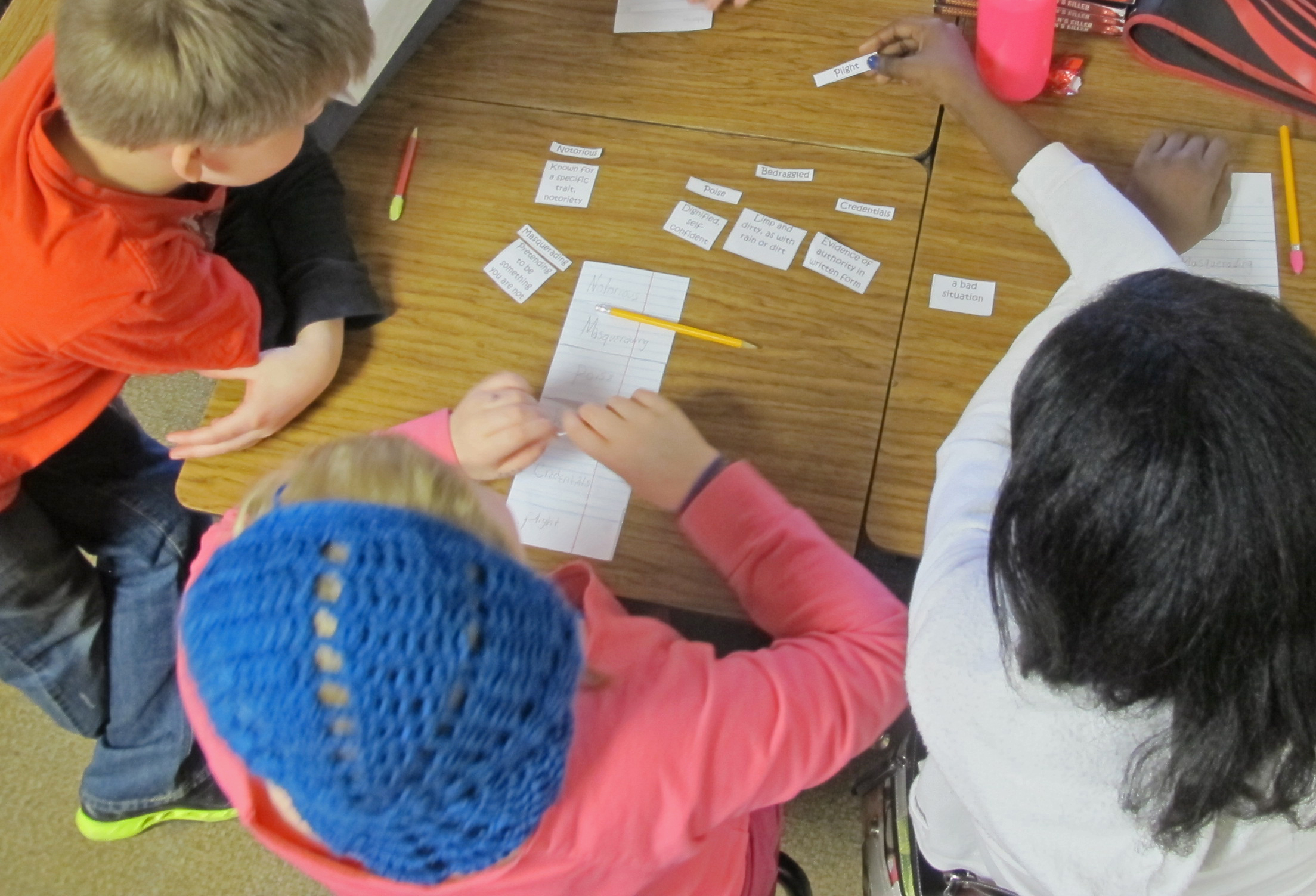
When we feel resistance to change, we must ensure that we’re doing the work needed to support that change but, we must not fall into the trap of believing all change must be slow and incremental. Sometimes we must have the courage to say, “ENOUGH! The body counts are in. We’re stopping this practice and beginning to do that practice instead. It’s time to unlearn, relearn, and change!”
Written for the April issue of the Arkansas Association of Educational Administrators newsletter
A Few Things My Parents Didn’t Do… (A note to my parents on their 63rd Anniversary)

Jimmy & Elsie Warnock celebrate 63 years of marriage on March 10th.
There are a number of things you never did….and for these I’m thankful.
You never argued in my presence. If you had disagreements, I never knew because you resolved things in private and presented a unified front as parents. Two parents on the same page is a force to be reckoned with and simplified my younger years.
You didn’t speak critically of each other. You had a genuine appreciation for each other’s talents and skills.
You never struck me out of anger. Oh, there were a few spankings along the way, but the carefully thought out discussion in preparation for a spanking was where the real teaching occurred.
You didn’t yell at me in a harsh way. You spoke to each other and to your children in a respectful tone, even when you were disappointed or upset.
You never discouraged me. You tended to encourage my interests even when you might have liked to shape them in another direction. Sorry about the drum related headaches.
You never dropped me off at a school music performance and picked me up later. You stayed and watched the performance. Any criticism was mild. “Why did the drummers keep talking during the performance?” Your message to stop talking was received.
You never acted as if you were sacrificing anything for us even though you were. I remember daddy’s early morning departures for work and years of shift work so he could provide for our family. I remember mother grading tests and spending time reading to prepare as a teacher.
You never lost commitment for each other. I remember hearing your late night conversations and knowing that you were committed for the long haul.

My father writing a letter to my mother in the early 1950s from Korea.
You never fail to recognize each other’s strengths. I remember daddy saying on several occasions, “It’s amazing what your mother can do.” I remember mother bragging on and thanking daddy for the work he did.
You didn’t make unreasonable demands on each other or your children. You depend on each other in a healthy way. This has become even more pronounced during recent years. You both confirm that the other has strengths that complete you and make it possible for you to continue to thrive as you do.
You never worried about having the “best” of everything. You taught me it is what you do with what you have that matters. Used or secondhand is just fine if it works. Note to Daddy: One exception I take to this lesson relates to lawn mowers. After spending so many Saturdays of my childhood watching you patch up mowers rather than mowing, I now own a very nice mower.
You never belittled what I said even when I was a know-it-all teenager. You listened even when you probably wanted to show me the irrationality of what I was saying.
You never tried to “go it alone” in life. You built friendships through your work, church, and your community. You tended to hang around other good people, sharing your strengths and learning from them. You made everything you were involved in better.
You didn’t criticize my wife. You treated her like a daughter and accepted her as a true member of your family.
You never rejected friends or family. You were understanding and showed love for others even when they made mistakes or seemed distant for a time. You’ve shown a tendency to forgive and move on with others.
To be continued….
Congratulations on sixty-three years together. That is an amazing accomplishment. I’ve been around to see fifty-eight of those years and have some credibility on the subject of your marriage and your parenting. I give you highest grades on both areas.
Thank you for your continuing commitment to each other, your family, church, and community. We are all blessed by your influence.

Jimmy & Elsie Warnock around 1953
The Work of Our Hands
I thought of this song today while doing classroom walkthroughs and thinking back on several of the wonderful classroom observations I’ve done over the last few months. I feel a sense of great thankfulness when seeing good teaching.
A masterful teacher rises to the level of sainthood described here in Carrie Newcomer’s song, “The Work of Our Hands.” People who are fully alive display a commitment to doing good work, whether canning tomatoes, laying bricks, or building young lives. Doing the best we can do with the task set before us is a high calling and one we must answer as educators.
A Doorway to Learning
Two sixteenth notes followed by two eighth notes. The interval was a perfect fourth, though I didn’t know that at the time. What I did know, at twelve years old, was that I was hooked on that sound. I leaned over to my mother and said, “I want to play those.” I was pointing at the timpani, sometimes called kettledrums. That concert changed the course of my life.

Timpani
There would be other musical high points along the way, like stepping close to a passing high school band during a parade so I could feel the vibrations of the drums against my chest. Later, as a member of that same high school band, I played timpani with a tingling up my spine as our low brass opened up on the First Suite in E-Flat by Holst. What a sound!
As a senior in high school with a well-developed defense mechanism against showing any emotion, I stood in an All State Choir rehearsal unable to sing for a few seconds as tears welled up in my eyes. The conductor gave me an understanding glance. I’m sure he’d seen other young musicians with similar reactions when immersed in such beautiful sounds for the first time.
Music was where I found everything relevant. It was like a doorway to learning in many areas. In music and the fine arts, I was able to apply learning from other classes in real-world situations. Music teachers provided some individualized learning which allowed me to stay engaged in subjects that I might have otherwise rejected. Music was where I built positive relationships with caring and competent adults. Music was where I formed lasting friendships around collective dedication to shared tasks and goals.

I’m thankful that music grabbed my imagination when it did. My fear is that children who need this opportunity today may miss out because of a narrowing curriculum in response to high-stakes accountability. Rather than narrowing, we need to broaden options while deepening the learning and avoiding the temptation of thinking greater standardization will result in higher standards.
If the fine arts are crowded out in the name of raising standards, we’re losing ground and possibly missing many students who could help us compete where innovation and creativity are needed. P. L. Thomas, Associate Professor of Education at Furman University said, “China seems poised to recognize the failure of standardization, while the US continues to call for more and more standardization. That should be shocking.”
I’m thankful that my parents took me to that concert when I was twelve and that there was an orchestra to hear. I’m thankful that I found an area I wanted to explore deeply; one which would ignite so many other areas of learning. I’m thankful that I work in a school district that recognizes the value of instrumental music, vocal music, theater, technical theater, dance, and the visual arts. I’ve seen the impact of the fine arts on our children and on the fiber of our community.
My hope is that, as we work to equip our children to compete on a national and international stage, we will not narrow the learning in an effort to show better test scores but insist on allowing students to explore the arts and creativity through as many disciplines of learning as possible. We cannot afford to do less!

Mr. Wendell Evanson, retired band director at Henderson State University. One of those lasting relationships built around music.
Thank you to my school music teachers. I could sit down and visit with any of these individuals like old friends.
Rogers Junior High (El Dorado): John Keane and Bob Endel (band) These guys worked with me patiently when I was at my most challenging age. I’m sorry about the firecracker incident…. and the gas heater incident…. and the drum stick/window incident…. and….
El Dorado High School: Hal Cooper (band & music theory) Mr. Cooper made us play a lot better than we deserved to play and he trusted me with some challenging percussion parts. Jim Foxx (choir) Mr. Foxx prepared us well for region choir auditions and made it possible for us to have some great musical experiences. Morris Graham (band) I didn’t have Mr. Graham as director but he gave encouragement to us all. Bob Adams and Dr. Gary Cook (private percussion lessons) Bob Adams taught me drum rudiments and introduced me to George Lawrence Stone’s Stick Control, a book I’d work with for years. I drove to Louisiana Tech each week my senior year for lessons with Dr. Gary Cook. He never worked with me less than an hour even though I was only paying for 30-minute lessons. He also gave me a lot of mallets as we worked together. He was a true musician and master of all things percussion.
Henderson State University:
Wendell Evanson (band and conducting), Mr. Evanson gave us some amazing music. He was relentless in pursuing excellence in all that he did. He was a master with the baton and a great encourager. He seemed to know when you needed a boost.
Doug DeMorrow (percussion), Doug worked on my musicianship and was patient with me. As a student, I was his first senior recital at HSU. Doug would later become quite well known for his beautifully crafted DeMorrow marimbas and other keyboard instruments. He’s a master musician and craftsman.
John Webb was my supervising teacher when it came time to do student teaching (now called internship). John was a great musician and teacher. He was patient with me as a beginning teacher and encouraged me to build relationships with and learn from great music teachers. He was a person of character, someone I could look up to and try to emulate.
Wes Branstine (jazz band and low brass). Dr. Branstine gave me private lessons during the summer after I realized I needed help in teaching brass players. He wouldn’t let me pay him. Curiously, I began to have good low brass sections after those lessons.
Written for the Arkansas Association of Educational Administrators March 2014 newsletter.
February School Newsletter
Here’s a link to this month’s newsletter.
Sharpening Saws and Shaping Beliefs
Sometimes memories seem to slip up on us and shake us by the arm saying, “Remember this? It was important! You learned a lot more than you realized at the time.” Here’s the story of just such a memory. It has influenced my thinking about teaching and learning in ways more profound and relevant to my practice as an educator than any number of graduate classes.
When I was twelve years old my grandfather, Arch Warnock (AKA Grampie), taught me how to sharpen saws during a summer visit in Smackover, Arkansas. He found an old saw blade in his shop that I couldn’t harm, loaded me up in his 1957 Chevy, and drove me to the local hardware store. He told the owner of the store he needed a saw handle because his grandson was going to learn to sharpen saws. He attached the handle and showed me how to tighten the blade into place on a rack behind his shop.
Then he went to work showing me how to use a tool to set the points of the saw. Alternating points had to be accurately set which meant I had to pay attention and not miss one. After setting the points, he taught me how to read the points and set my file. Consistently holding the file at the proper angle and moving it in a straight line were difficult skills for this twelve year old student. He placed his hands on mine and led me through the process, never expressing frustration at my faulty and sometimes clumsy first attempts. Gradually he let me take over while he continued to coach and make adjustments.
Then came the hard part…PRACTICE! He would leave me to work on my saw and then return in an hour or so. He tested my work by cutting a quarter inch piece off of a two-by-four. After a few quick strokes and a look at the saw blade, he’d scrape the tips off of the whole saw with two sweeps of a large flat file. This meant it was not cutting correctly and I would have to do the whole saw again. After watching me file and making suggestions, he’d leave me to my work.
This went on for several days during which I gradually gained some confidence, skill, and blistered fingers. I finished sharpening the saw for what seemed like the 75th time; now for the big test. As my grandfather made the first few strokes with the saw, I noticed a smile forming around the mouthpiece of his pipe. He sawed clean through the wood in a few smooth strokes, stood back and declared, “That saw will cut!”
I’ve never forgotten the pride I felt as my grandfather proclaimed the saw would cut; that saw I sharpened would cut! This was an early taste of real self-esteem, the result of struggling to learn something new and coming out on the other side with the ability to perform a task that seemed impossible in the beginning.
My grandfather did the following:
1. He gave me a clear goal and made it relevant to a real world problem.
2. He set a high standard and believed I could meet it.
3. He coached and encouraged me while giving honest feedback about my performance.
4. He gave me opportunity to practice in a hands-on way.
5. He showed unconditional love for me regardless of my skill and celebrated my success.
I did not make a career of sharpening saws, but I think Arch Warnock would be pleased that his grandson is a school principal and that those lessons in sharpening a saw have shaped my beliefs and influence my work to this day. When I see students succeeding because of the work we do in our school, I sometimes imagine my grandfather looking on from a distance and saying with a smile, “That saw will cut!”
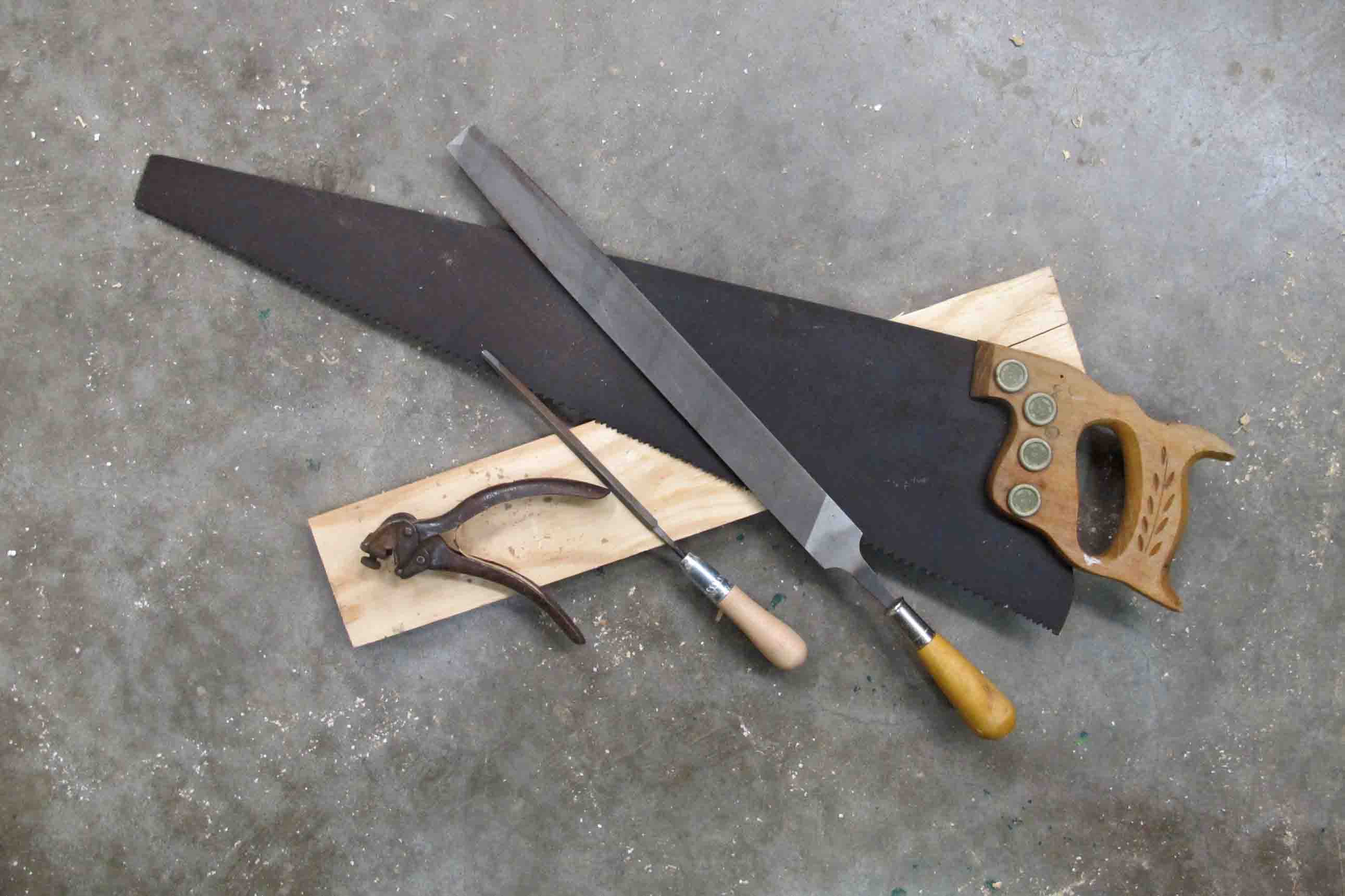
The saw my grandfather gave me along with a point set tool.
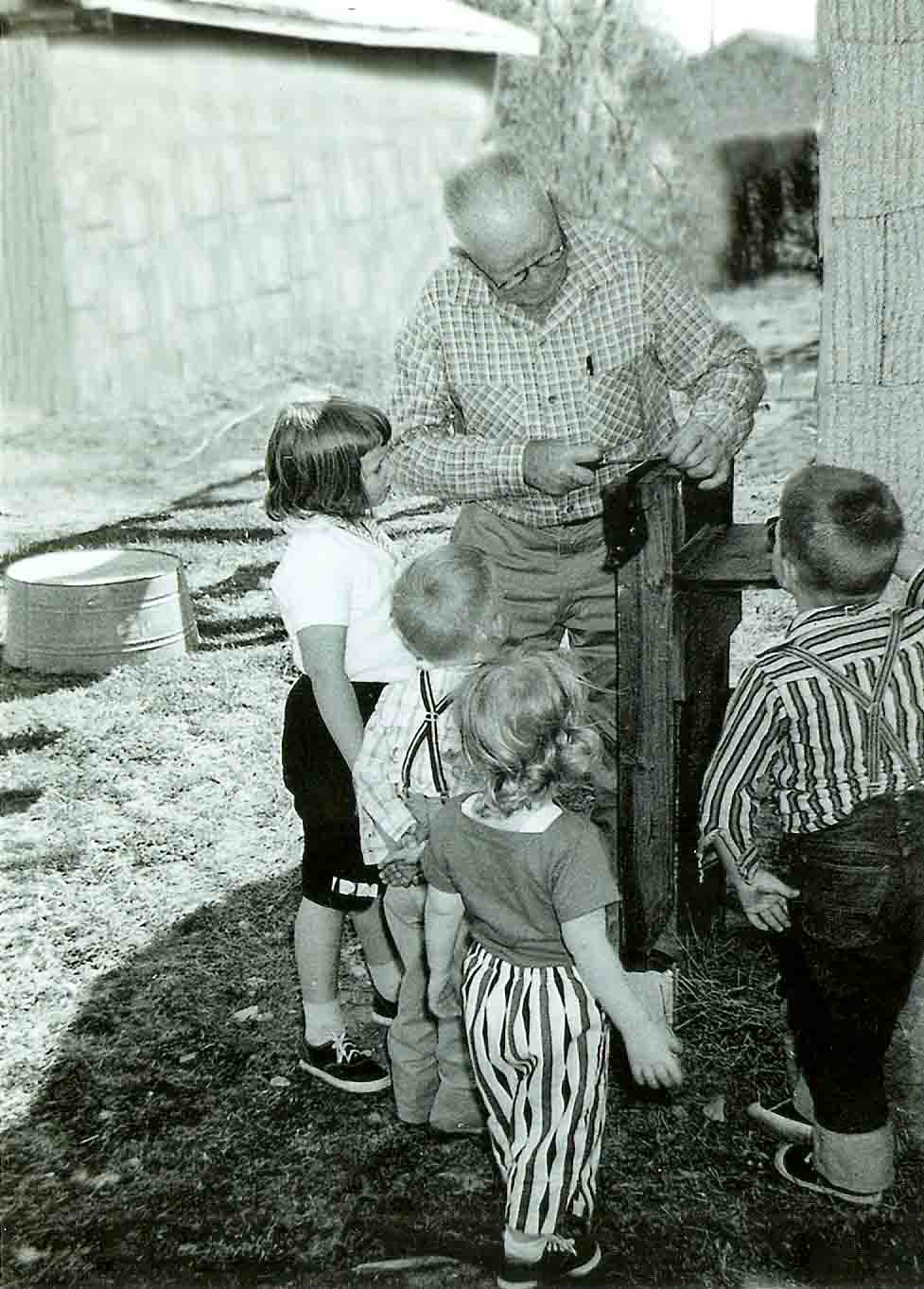
Grampie sharpening a saw as his grandchildren looked on. I’m second from the left.
“CAN You Draw a Texas Longhorn?”

My mother with older brother, Reese Kennedy
Yesterday I was reminded that January 4 would have been my Uncle Reese’s 90th birthday. He was my mother’s older brother and she loved him very much. As a child, I was in awe of him because he was an artist. As an adult, I was in awe of him because of his adventurous spirit, his open questioning mind, and his talent.
When I was 5-years old we were visiting Uncle Reese and his family in Dallas. For reasons I can’t recall, I was obsessed with Texas Longhorns. Shortly after we arrived I approached Uncle Reese as the adults were visiting and asked if he would draw me a picture of a Texas Longhorn. He said he’d do this later and continued to visit with my parents.
I approached my uncle several more times over the next day or two and each time he was polite but probably assumed his five-year-old nephew would become obsessed with something else if he delayed.
My mother tells me that I finally approached my uncle and asked clearly, “Uncle Reese, CAN you draw a Texas Longhorn?” He quietly got up and led me to his art studio where I watched in amazement as he made a Texas Longhorn appear before my eyes with ink and chalk. He then signed it “TEXAS LONGHORN drawn for Jim Warnock, Thanksgiving 1960, Reese Kennedy.”

This hangs on the wall of my living room today and I treasure the memory of that one-on-one time with my uncle as I watched him produce this drawing.
I’m not sure that this early success at getting my Uncle Reese to do what I wanted him to do predicted my future work in education or administration but he and his family definitely shaped my thoughts about the place of Fine Arts in education. I view the arts as central to learning. They are not optional but an essential part of any effective curriculum.
I’m thankful for my Uncle Reese and only regret that we were not able to spend more time with him and his family.
Additional historical note: Four years after this event, Reese Kennedy founded, and was the first president of, the Southwest Watercolor Society. This association of artists continues to this day.

Reese Kennedy in front of his home in Nacogdoches, Texas a number of years ago.

Reese painting in Mexico.
April, 2016: Thank you to one of Reese’s former students for sharing the following newspaper clippings. He also shared the following comments about his memory of Reese.
Reese was one of my heroes. I only have three heroes so this is a sincere complement. The other two heroes are my dad and my high school football coach, the two heroes that sent me to SFA on a football scholarship in 1965. On arrival to SFA, I visited the art department and had a short conversation with Reese. I was sold immediately on signing up in his classes, not sure of which ones, but that is not important as I sooner or later took all of them. I was hooked on his personality and charm, not to mention his love for the arts and water coloring quest for excellence. – Mike Mikulenka


What Should We Fear?
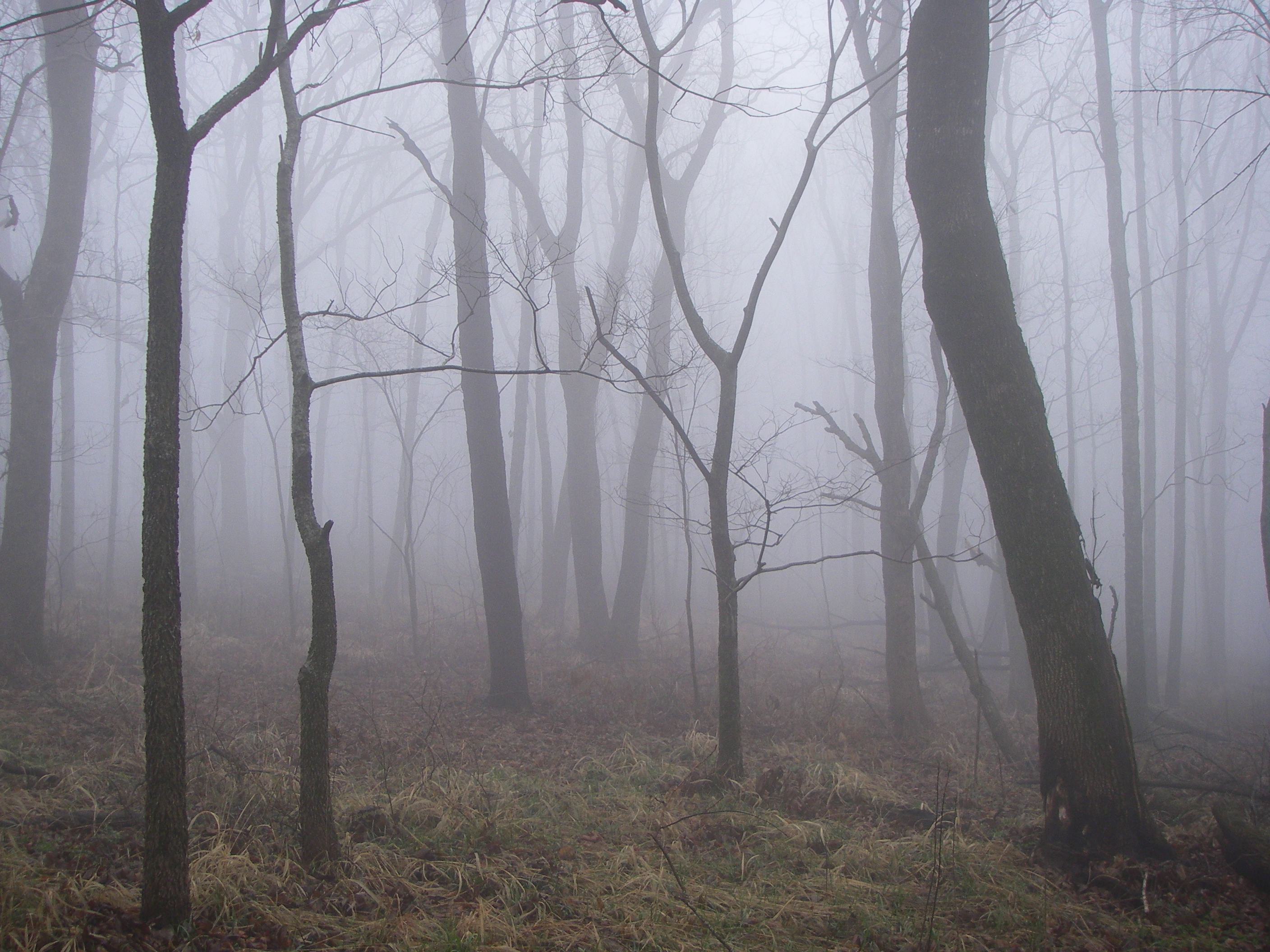
Foggy morning on the Ozark Highlands Trail
“Aren’t you afraid of the bears?” This is a question I’m often asked. It’s usually followed by, “And what about the snakes?” I’m far from fearless, but bears and snakes do not even make my top five when backpacking.
Here are my wilderness fears in priority order.
1. Dehydration
2. Heat exhaustion
3. Hypothermia
4. Bee stings or tick bites
5. Falls (especially at creek crossings)
Fear is a good motivator and can keep us out of trouble, but irrational fear can only paralyze. I know someone (an excellent teacher) who will not step foot into the woods because of fear. She is sure that bears and snakes are hiding behind trees, ready to attack. While I’m respectful of bears and don’t sleep with a raw steak in my tent, I would consider it a treat to see an Arkansas black bear at a reasonable distance. I was once enjoying a freshwater spring and noticed a snake a few feet away curled up in the leaves. I decided to move quietly down the trail, but the image of that beautiful copperhead made the hike memorable.
Like my friend’s obsessive fear of wildlife, I think we educators sometimes fear the wrong things. I’d like to retrieve those sleepless nights caused by my irrational fears. Are we ready for Standards Review? What if we worded some ACSIP actions incorrectly? What if I don’t pass Phase II of TESS? I could go on, but you get the idea. Obsessing on these areas didn’t solve anything. In some cases, they distracted me from more important areas that impact students.
As an educator, here are a few legitimate fears I have (in no particular order):
1. Spending time and energy on the wrong things.
2. Overlooking or missing students who are in need.
3. Making a mistake when hiring a new teacher.
4. Failing to help those around me grow professionally and personally.
5. Reaching a point where I’m not learning and growing.
Preparation and planning can make a difference when facing legitimate fears. Want to avoid dehydration in the woods? Pack a water filter and study your map to see where water sources are along your route. Sometimes route adjustments are necessary to avoid water shortages while hiking. The same holds true as an educator. We must prepare and make adjustments based on things that matter.
If I fear spending time and energy on the wrong things, then I should work with my staff so that we base actions on priorities and evidence. I must learn to prune out actions that don’t move students and teachers forward. I should speak up for AAEA legislative positions that help us avoid directives that take away from the essential work of teaching and learning.
If I fear that I might fail to help those around me grow professionally, I should involve staff in preparing their professional learning to ensure that it is relevant to their professional growth plans. We must ensure that adult learning facilitates children’s learning. I can make my teachers’ professional learning a priority and recognize their growth.
Being involved in the AAEA can alleviate my fear of becoming stagnant in my own professional learning. I’m often surprised when I trace an effective action back to its beginning and realize it was based on something I learned while networking with peers through the AAEA, and my two constituent organizations.
We’re all motivated by fear to some extent, and that’s probably healthy. Will we be paralyzed by irrational fear, hunkering down and hoping for the best? If we’re motivated by legitimate fears that will negatively impact students and teachers, then thoughtful actions could reduce those fears and help us all move in positive directions. We might also get a better night’s sleep.
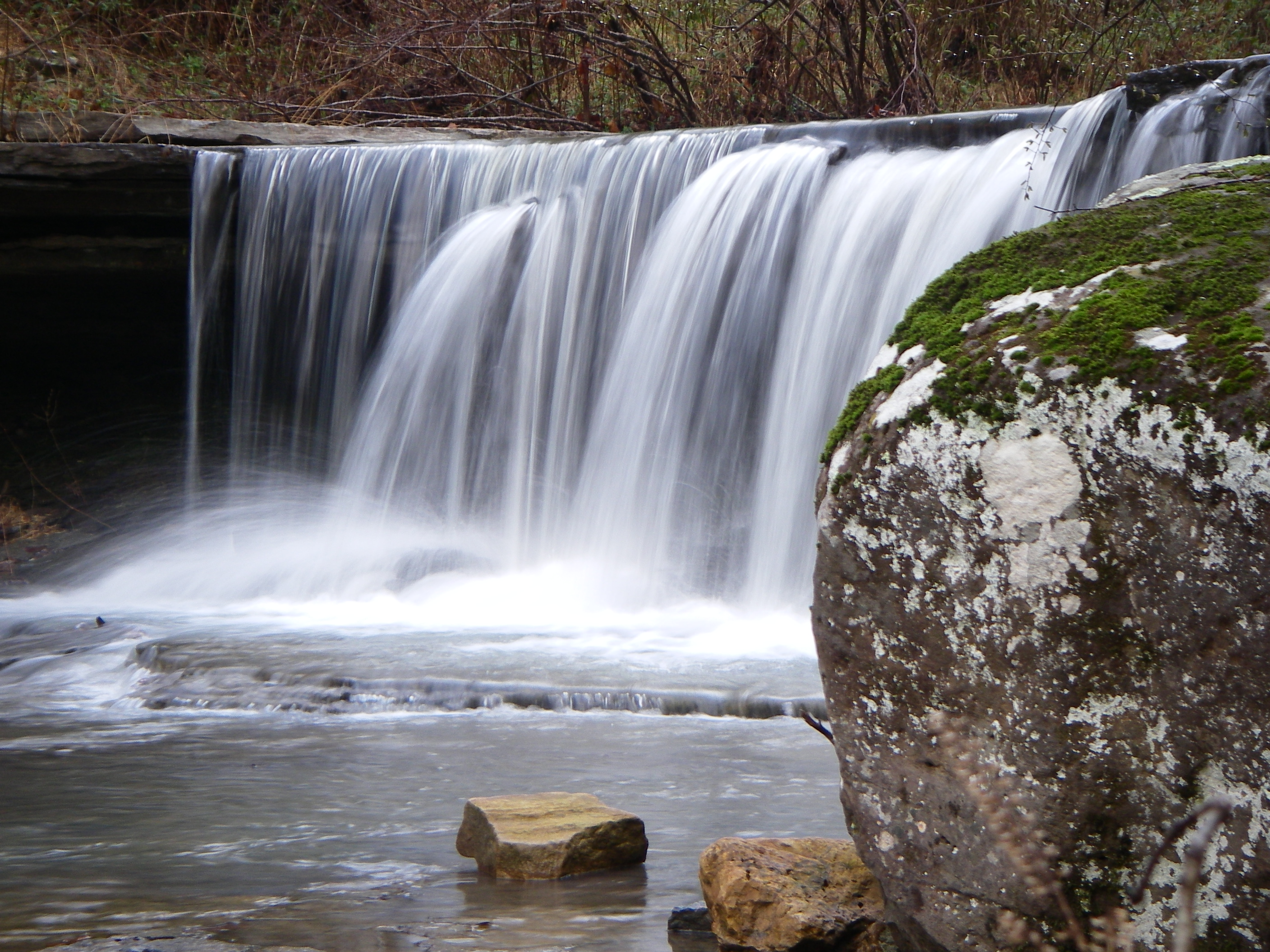
Nice place to quench your thirst on the White Rock / Shores Lake Loop Trail
The above was written for the January 2014 issue of The Administrator newsletter published by the Arkansas Association of Educational Administrators.
Burnout?
Written for the December 2013 newsletter of the Arkansas Association of Educational Administrators.
I was sitting next to a wise and experienced superintendent at AAEA in August. During a short conversation he said, “I’m concerned about the principals in our state. With everything that is coming down on them right now, I’m afraid we’re going to see burnout.” This comment caught my attention and privately I thought, “Not me. I’ve never had a problem with burnout.” Funny how those little arrogant thoughts come back to bite you. While I have not experienced serious burnout, I have felt completely overwhelmed and inadequate at times.
You may have experienced taking a drink from a garden hose as a child when the pressure turned out to be greater than expected. You ended up with a nose and throat full of water. As an educator, I feel as if I’m drinking from three firehoses at once. My “big three” are Common Core State Standards (CCSS), Partnership for Assessment of Readiness for College and Career (PARCC), and Teacher Enhancement and Support System (TESS). I thought there was a fourth firehose with LEADS (the principal evaluation system), but I told my superintendent after the training that I downgraded it to the garden hose variety. In light of the “big three,” it just does not rise to the same level.
Two of these “big three” firehoses have the potential to positively impact education in Arkansas if implemented in an intelligent and balanced way. My belief in the benefits of PARCC is on hold for now. Any one of these “big three” should be a focus for 3-4 years to ensure thorough and clear implementation, but that is not an option.
I find great value in Charlotte Danielson’s Framework for Teaching, but even the piloting phase of TESS seems rushed and sometimes unclear. I do not see this as the fault of the leaders of TESS, but regret that the law does not provide for a more gradual rollout. It would also have been nice to hear directly (on video or in person) from some of the scorers (those education experts sitting in the corners of video lessons we watched).
On our campus, we’re presently doing walkthroughs, informal (formative) and formal (summative) observations. Going through the process with a novice teacher recently was very rewarding. Her reflections on the lesson observed were specific and insightful. We’ll continue to revisit her Professional Growth Plan and formative observations throughout this school year, but just the formal observation, sorting and scoring evidence, and pre and post conferences occurred over a four-day period and took a number of hours.
With practice, we’ll get faster and this is where a major portion of our time should be spent, but I fear the process will become rushed and less effective as time grows short. To add another challenge to the mix, it is important to maintain positive relationships with teachers as we implement TESS. They are overwhelmed, too.
In general, CCSS and PARCC both warrant much greater volumes of professional development than we have been able to invest. Over the last two years, our teachers have spent approximately 100 hours on CCSS and PARCC, yet we’ve only scratched the surface.
For me, PARCC looms out there like some great unknown. By studying sample items, we get some indication of the type of challenges we’re looking at, but great uncertainties surround the administration and readiness for these assessments. Charlotte Danielson’s comment in Education Week about the new assessments is revealing.
I’m concerned that we may be headed for a train wreck there. The test items I’ve seen that have been released so far are extremely challenging. If I had to take a test that was entirely comprised of items like that, I’m not sure that I would pass it—and I’ve got a bunch of degrees. So I do worry that in some schools we’ll have 80 percent or some large number of students failing. That’s what I mean by train wreck.
Some large strides have been made in the past when we faced difficult issues. I am hopeful that we’ll see new gains in our future as we struggle through the present trials. The task here is to do good work and stay focused on what is important and under our influence. Nothing fights burnout like doing a few things well and having a positive impact on others.
When I feel overwhelmed I like to do the following:
1. Visit the self-contained special education classroom with our most severe special needs students. As I witness the magic of teachers working with students struggling with major physical and mental challenges, my perspective comes back into focus.
2. Sit down at lunch with students and have a conversation. From these visits, I learn what is, or is not, working for them and what they are thinking.
3. Take action! My mother often says, “When in doubt, take a step.” When that nagging sense of being overwhelmed tugs at my mind, I look at my plan and get busy. There is no time for burnout when you are doing work that matters and meets the needs of others.
If you’re feeling overwhelmed, you have plenty of company. Gain strength and encouragement from your peers in the AAEA. When you reach the point of frustration, call a trusted educator and express that frustration. I’ve done this on at least two occasions this year and found it very helpful. If you don’t have an action plan for fighting burnout, make one. Keep it simple and focused on where you can make the biggest difference for students and their teachers.
 Principal Notes