Home » Posts tagged 'alma intermediate school' (Page 3)
Tag Archives: alma intermediate school
Poetry Slam Builds Enthusiasm and Courage for Writing
Imagine fifth grade students filled with excitement about writing two weeks after state testing? The Fifth Grade Poetry Slam at Alma Intermediate School builds enthusiasm for writing and adds a new instructional focus at a time of the year which might easily suffer from an emotional dip. “The experience was awesome! Reading in front of everyone got my spine a-tingling,” said one fifth grader. The poetry workshop is funded through the Arkansas Arts Council Mini Grant Program.

Clayton Scott leading a poetry session.
Nationally recognized guest poet, Clayton Scott, spent one week working with fifth graders in poetry sessions and taking students to the next level in their expressive writing. Mr. Scott met with all 260 fifth grade students each day. More than 1,200 poems were written by students during the week. Scott taught a variety of poetry styles and techniques along with creative tools that help even the most reluctant writers engage in the process.
A major focus of the week was encouraging students to “confront their inner chicken.” Students were challenged to stand up and speak out as they wrote and shared their poems. “I liked writing my poems and learned that fear shouldn’t keep you from doing something. I learned to confront my inner chicken and how to write better poetry,” said one typically reserved fifth grader.

Mr. Scott used an eagle graphic to represent a balanced approach to writing. For students’ writing to “soar” it takes a balanced effort by both wings. One wing contains the mechanics of good writing. Mr. Scott doesn’t dwell on these elements because they should be in place and are accomplished in editing. He places great emphasis on the creative wing which contains sensory imagery, power words, simile, metaphor, and many more. According to one student, “The experience was awesome. I learned how to use expressive language in all of my writing.”
Students had writing assignments each night based on poetry techniques taught that day. As students shared their poems the following day, Mr. Scott coached students on speech, delivery, and expressive reading.
The week culminated in a Poetry Slam open to the public. Finalists from every class were in competition on the final afternoon. Students were selected to act as judges for the Poetry Slam. Students were designated as masters of ceremony and filled other duties for the event which gave a strong sense of student ownership.

Student performing his poem at the slam.
A total of twenty-six finalists performed in the Poetry Slam along with Clayton Scott. Five students were selected as overall trophy winners. It was noted that some students who had not exhibited outstanding writing in the past came to the forefront in the poetry competition. It was a great chance for students to celebrate the successes of their peers. One finalist said, “At the poetry workshop I learned that you can have courage and express the stories of your life through poetry.”
Courage and creativity are exactly what our children need! Alma Intermediate School has found that poetry is a tool for helping students acquire both of these qualities.

Clayton Scott, guest poet, reminding students to confront and defeat their “inner chicken.”
R-E-A-P: Harvesting the Good by JD Finley
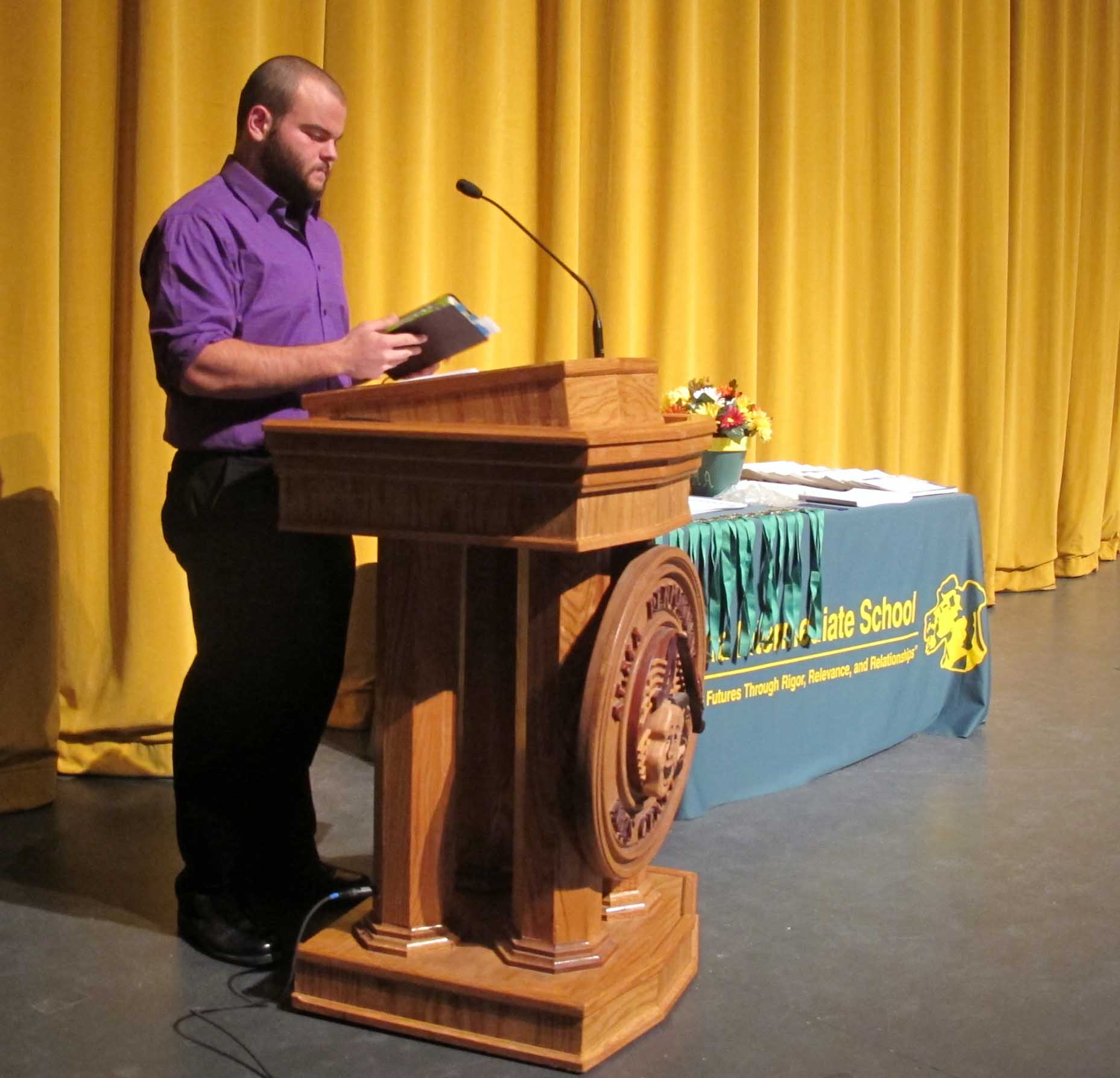
JD Finley
From a speech given by JD Finley for Alma Intermediate School 5th graders on May 23, 2013
JD Finley graduated from Alma High School in 2012 and is currently a student at UAFS.
My name is JD Finley. I graduated from Alma last year as one of eleven valedictorians, which means I was at the top of my class. I had all A’s every year of school and graduated with Honors. I played football and threw discus until I tore my ACL my sophomore year. I have a sister. I love Reese’s Cups and bacon. I love to read. And I like short walks to the refrigerator.
One of my passions is for kids your age. When Mr. Warnock asked me to speak here, I panicked because I was afraid of you guys. I know I’m a big guy with a beard, but I was scared of y’all… still am a little bit. I also don’t like speaking in front of people, but I got to praying and thinking about it and I decided that I would “cowboy up” and speak to you guys with the hope that I might be able to make your education more beneficial and give you some tips that will help you reach your goals.
I sat down and came up with an acronym for the word REAP, R-E-A-P which means to harvest or gather, I’ll come back to why I chose that word at the end but for right now, I want to begin with the R which stands for Respect.
Respect
What we just did by clapping for your teachers was show them some respect for all that they’ve done for you. But I’m not just talking about giving them a round of applause when I say respect. I am talking about showing them respect in the classroom for their authority. They became teachers to help you and educate you in preparation for life. Yes, I’ve had a few teachers that I didn’t really enjoy or get along with, but I always shown them respect. I think if you asked every teacher in here what they thought the biggest non-academic problem was they’d say disrespect. If you want to make the most out of your next seven years, not even that but the rest of your lives, respect goes a long way with anyone you come into contact with.
I don’t mean just respect for teachers, I mean fellow students as well. No matter how different you are from someone else or how much you disagree with them, you should always show them respect and compassion. I don’t know how many of you have heard or read about the Good Samaritan, but it was an example used by Jesus to explain what it means to show respect and compassion for another person. The story is told in Luke chapter 10 verses 25-37 but I’m just going to read 30-35.
In order to understand just how compassionate and respectful this act was you must first understand that the man who was beaten was Jewish, and the rescuer was a Samaritan. And Jews and Samaritans were bitter enemies. This would be like if I was beaten by robbers and left on the side of the road. An Alma person passes me by and does nothing. A Van Buren person passes and looks away, but a Greenwood person stops and takes care of me. As much as I don’t like Greenwood, that’s true compassion, to be able to think and care for someone else regardless of how different you are.
Ethics
To have ethics means to live by a certain code or rules that govern your behavior. I believe having ethics is important to obtaining a healthy education. Part of living by a set of ethics is striving to have character and knowing right from wrong. Like one of my heroes Dr. Martin Luther King Jr. said, “Intelligence, plus character, that is the goal of true education.” If you will start now developing character and doing the right things, people will notice. It may be hard sometimes but there is nothing more rewarding on earth than having a clear conscience and knowing you did the right thing.
When I was an 8th grader I had a teacher that gave us a test and left the room. Everyone in that class started talking about the questions and answers, passing them back and forth. I was tempted to do the same because the teacher would never know about it. But I didn’t give in. I sat there and never said a word even though some of them were trying to talk to me. I knew that they would probably all have higher grades than I did on that test, but I would still have my clear conscience.
I abided by my set of ethics and did right rather than wrong. I kept my character while everyone else compromised theirs for the sake of a test grade. I wanted to do my best at everything even if that meant me getting a B or a C, but MY best, not someone else’s best, which is what I would be doing if I cheated off of another person. I cared more about who I was on the inside – my character, because that lasts a lifetime rather than my grades which only last a semester. I said all of that to say that education is not enough if you do not do the right thing as well. An educated person who has character is an extremely powerful combo….. okay on to the next letter… A.
Aspire
Aspire. To aspire means to hope, dream, or to strive for a goal. One of the biggest things that helped me in my school career is goal setting and management. I believe it is a central key to unlocking wherever you want to go in life. It is not enough to just dream about something, but rather make an action plan to achieve that dream. That’s what aspiring is all about.
When I was in the 5th grade I got knocked out of the school wide spelling bee close to the end. I told myself that by the end of my 8th grade year I would win Crawford County and go to the state bee. So each year I studied harder and practiced longer for it. Each day after that I made sure that I was doing all that I could do to put myself in position to achieve that dream, and you know what? I did it. I made fourth place my sixth grade year in the county bee, third place my seventh grade year, and my eighth grade year I won the Crawford County Spelling bee and ended up being the 20th best speller in the state, all because I aspired for that dream.
The same thing happened for me to be a Valedictorian of my class. When I was an eighth grader I saw the valedictorians together on stage at graduation and I decided that I would be one of them when I graduated. So I did everything I could to put myself in that position. I wasn’t the smartest by any means, but nobody on that stage could have said that they worked harder than I did to be there. All because I set up a plan to make that dream a reality.
Whatever you want to be in life, whether that’s a doctor, or a lawyer, or a trash guy, or maybe a mail man, or even the President, set up a plan to achieve that dream and get after it. Nobody is going to just hand that to you, you have to work for what you want in life. So set a goal, make a plan, and work to achieve it. Aspire higher…. Now for the last letter P, probably my favorite.
Passion
I chose the word passion because I wish that I had developed a passion for learning when I was your age. The dictionary definition of having a passion for something means you have a strong liking for or devotion to some activity or concept. But I would put it like this: If you have a passion for something it means you would be willing to do it for free because you enjoy it so much.
Your passion is whatever you do when your work is all done and you have time to yourself. I have multiple passions in my life, but it wasn’t until my junior year of high school that I truly enjoyed learning about every subject. Until that point my two favorite subjects were History and English. I didn’t like science and hated math. But when I became a Junior I heard a speech by Mr. Valentine, the high school principal that totally changed my view of learning. He said “If you truly want to succeed in life and make a difference, then see to it that you know EVERYTHING about something, and SOMETHING about everything.”
Now I’m not telling you guys that you have to know everything about something yet, because that will come later, a lot later. I still don’t know everything about something. What I am hoping you will take from this is the knowing something about everything part and seizing the opportunities to learn between now and your last year of high school. I really wish that I had paid more attention during my middle school years to science and math. It would have helped me when I got to High School. If you struggle with a certain subject or are weaker in an area like I was in math and science, don’t just give up on it. Try your hardest to understand those concepts. Put more time into those weaker subjects because I promise you it will pay off in the long run. If you develop a passion for learning you will never cease to grow.
So to sum it up, if you put all four of these principles together you get Respect, Ethics, Aspire, and Passion. R-E-A-P. Reap. Respect everyone, Ethics in the classroom, Aspire higher, and Passion for learning. When you apply each of these concepts to your life, you will gain the benefits of being a well-rounded student, and not only that but a well- rounded human being.
I hope that maybe this has made you guys think about what kind of person and student you want to be. If you have any questions or just want to talk I’ll be here for a little while after the assembly so feel free to come by and say hey. I’m kind of shy but I’d love to answer your questions. Thank you guys for listening!
Parenting…Perfection Not Required

My parents raised two children and have celebrated 60 years of marriage.
I had great parents but didn’t realize this until around age 25. They’ve become more impressive to me with each passing year. What made them great parents? I’d like to list a few things that stand out to me.
They were there… My parents made an effort to attend performances and sporting events I was involved in. More importantly, they were there emotionally at home. We had conversations and they let me know that I was an important part of the family….not the center of attention….not the center of their universe, but an important part of the family.
They had expectations of me. They gave me jobs around the house and expected them to be done. They expected me to do well in school. They expected me to work and earn a living. They expected me to respect others. The list goes on but you get the idea.
My parents treated each other with respect. They may have gotten a little cross or edgy on rare occasions but always in an atmosphere of mutual respect.
My parents loved me unconditionally but also let me experience negative consequences. They never cared less about me because I made a mistake but they did require that I face the consequences of my actions. Consequences could be unpleasant but I knew they loved me no matter what.
Parenting is a difficult task! My parents have often said they weren’t perfect but I don’t think perfection is required. Giving yourself to the job of parenting and doing the best you can each day is the key.
As an educator, I’m thankful that parents are willing to trust us with their most precious possessions, their children. Children will someday recognize the good work their parents and teachers do and we will have the satisfaction of seeing their continued growth and learning.
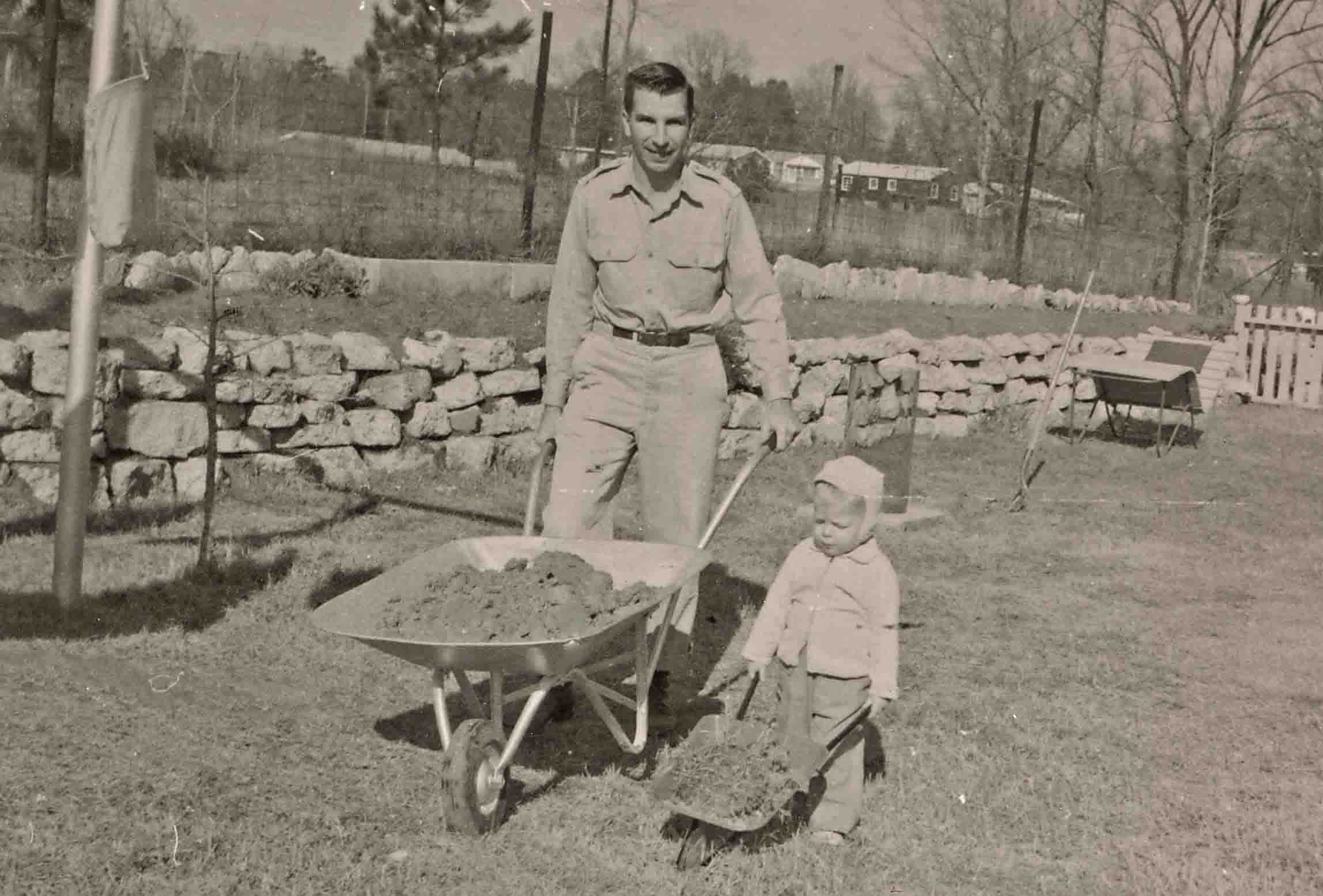
This is me trying to help my dad.

My parents flanked by me and my sister.
Year-Long Internships Showing Evidence of Success

Year-long intern working with 3rd graders at AIS
“The year-long internship made me much more confident as a first year teacher,” said Meredith Maestri, a novice teacher at Alma Intermediate School. Jim Warnock, principal added, “Parents were sure Miss Maestri had teaching experience. They were surprised to learn that she was a first year teacher.”
Alma Intermediate School is one of several schools partnering with the University of Arkansas Fort Smith in an effort to increase the confidence and effectiveness of novice teachers by adding a year-long internship option for selected students in the elementary education program. Early indicators are that this program is improving teaching skills of the interns, as well as confidence levels. Principal Jim Warnock interviewed interns, mentor teachers, and students, to gage the benefits and challenges of the program halfway through the second year. During the pilot year (2011-12) the first two year-long interns were placed on campus with two more being placed this year.
Early signs are that year-long internships are beneficial for the teacher candidates and the students in the school. Interns and mentor teachers stated that the year-long internship allows teaching candidates to build strong relationships with staff, students, and families. Dawn Stewart, mentor teacher said, “It helps interns to build a stronger relationship with students because they see them throughout the school year. They see that growth along a continuum throughout the year.”
Interns also benefit from collaborative times built into the school day such as grade-level meetings and subject area sessions. When teachers are involved in professional development, their interns are involved as well and contribute as any other staff member would. Mentor teacher, Emily Baldwin said, “The interns have a better understanding of the curriculum because they’ve worked with it from August to May.” Another mentor teacher, Shea Klomp added, “They also know what it takes to establish classroom procedures and culture because they are here in August and see how this impacts learning throughout the year. “
The teacher candidates gain confidence through the year-long association with the same school. Samantha Lopez said, “There’s a sense of great confidence that you receive as a year-long intern because you know your classroom, you know your mentor teacher, and how your school is run and the procedures of your mentor teacher.”
To pilot the year-long internship, the university provided dual programs with most continuing in semester internships while allowing interns to apply for the year-long path. During the spring prior to their internship teacher candidates are interviewed by participating school principals. The principals view this with seriousness due to the year-long commitment. Jim Warnock said, “Being on campus all year, an intern will have a great impact on our students and teachers so we want to be sure that the impact is positive. The interview is a time for the intern to see our values and philosophy as well as for us to determine whether or not we want that intern to be a part of our staff.”
Interns develop a high level of commitment to the academic growth of their students due to the longer time commitment. University staff have seen evidence of instructional growth among interns due to the greater depth of collaborative learning with grade-level and subject area teachers in the host school. They have seen year-long interns using deeper language about teaching and learning due to this close work with host educators. Mentor teachers and interns are trained in co-teaching strategies to take advantage of having an extra instructor in the classroom.
Moving to a year-long internship has required that the university make adjustments in the Block II courses which were traditionally taught during the semester prior to a traditional single semester internship. These courses are scheduled during blocked times on Monday and Wednesday so that interns may work with their supervising teachers on Tuesday and Thursday. During the second semester interns are at the host school every day.
Some alignment issues revealed themselves as interns applied new teaching skills at an accelerated rate from previous years. Some theory and content had to be taught earlier in the first semester to accommodate year-long interns who were actively practicing strategies much earlier than in the past. UAFS is adjusting other aspects of the internship based on input from participants and partner schools.
A fourth grade student who has experienced both semester and year-long interns said, “I like having an intern all year because she is able to help us, especially when the teacher is busy with someone else. She knows us better, too. Our intern worked with us during math and literacy stations and in writing workshop.” Without exception, students who’ve experienced both options said that they preferred having an intern all year long.
Based on preliminary evidence, year-long internships are something that Alma Intermediate School wants to continue. The partnership between the University of Arkansas Fort Smith and Alma Intermediate School will continue to grow and develop as input is gathered from interns, mentor teachers, students and university staff. One educator said, “Based on what I’m seeing, I would not want to go back to single semester internships. Our year-long interns are prepared to hit the ground running their first year and have deeper professional relationships that will help them grow as a teacher.”
This was written from interviews as well as content pulled from the presentation of several participants during this year’s Professional Development Schools Conference.
Alma Intermediate School: Emily Baldwin, Paige Brazil, Jo Ann Jordan, Shea Klomp, Meredith Maestri, Dawn Stewart, Jim Warnock
Interns: Samantha Lopez, Dorothy Boyd
University of Arkansas Fort Smith School of Education: Barbara Hunt, Deebe Milford, Laura Witherington
 Principal Notes