Home » Uncategorized (Page 9)
Category Archives: Uncategorized
PARCC – The True Costs

What follows is a letter I wrote to my state legislator a few weeks ago. She listened and was positive in her response and for that I’m grateful. We’ve worked hard to make the best of PARCC testing and to make it as doable as possible for teachers and students. I decided to share the following letter more widely after watching our first three days of PARCC testing.
We intend to see this testing through because much has been invested in training and preparation by students and adults. Completing this task is also our job. Hopefully, this is a learning experience that will help us avoid repeating this type of testing again.
I’ll begin with a disclaimer. I am not a statistician or state policy expert. I am a school principal with ten years of teaching experience prior to becoming a principal. My views on the cost of PARCC (Partnership for Assessment of Readiness for College and Career) are from the school level, observing teachers and students every day in the classroom.
I apologize for stating the following “qualifications,” but want to make it clear that I take education seriously, expecting accountability from students, teachers, and myself. In 2006, I was selected as a National Distinguished Principal representing the state of Arkansas. I’ve completed Phase III of the Arkansas Leadership Academy’s Principal Institute and have served as president of our state’s elementary principal association and more recently, the Arkansas Association of Educational Administrators in 2013-14. We, along with the other schools in our district, received rave reviews from the AdvancEd team site visit last year. We embrace accountability!
I recently wrote a short history of assessment in Arkansas for our parents, trying to frame PARCC in positive terms with hopes that we will see changes. After taking students through the Infrastructure PARCC practice, I am now truly appalled at how we are going to assess students in Arkansas. Implementing the Benchmark Exam was a challenge, but doable, and its use has helped us make great gains in Arkansas. I supported the implementation of more rigorous assessments and became deeply involved in working to improve students’ reading, writing and problem solving skills. I see value in the Common Core State Standards and have supported their implementation in spite of occasional pushback from stakeholders. The implementation of PARCC takes us to a sad place in Arkansas schools.
The cost per student for the PARCC is $23.97 plus a small administrative fee according to the PARCC website. The true costs of PARCC are incalculable and depend on many factors at the local school level.
For several years, school districts have made their best guesses on what technology would be needed for PARCC assessments, and millions of dollars have been wasted in some districts. Information from Pearson to district technology specialists has changed over time, causing false starts and inefficient use of funds as districts tried to anticipate and prepare for future needs.
The PARCC is costing our students immense losses in learning content and quality. Schools are trying to teach students specific technology skills simply so they can take the PARCC. These technology skills are not occurring at developmentally appropriate times for students. Many states have been giving computer-based assessments for several years, but these tests did not require students in the third grade to toggle between multiple pages and passages to answer a question. The PARCC requires keyboarding skills that are not appropriate for 8-12-year-old children.
The testing window is costing instructional time in an already short school year. The Performance Based Assessments (PBA) window is March 9 – April 9. It will take four weeks if the weather cooperates, for our school to work through the first round of PARCC due to limited number of computer labs and a desire to avoid exhausting students with all-day testing.
The End of Year (EOY) assessment window is April 27-May 22. It will take our school two uninterrupted weeks to complete this assessment with all of our students. Together, testing will occupy six weeks on our campus if there are no unforeseen interruptions. On any given day, rather than students acquiring technology skills needed for their future, computer labs will be occupied by students taking the PARCC. Long testing windows will cause instructional schedules to be in flux during these weeks, complicating lesson planning and the orderly sequence of instruction.
For a high school principal’s view of PARCC with a focus on instructional disruption I recommend the following: Surely You Can’t Be Serious by Mikkel Storaasli
PARCC Costs in terms of positive school environment:
School personnel are being misused because of PARCC. Our school is grades 3-5, so all grade levels are tested. Our assistant principal and literacy intervention teacher have spent countless hours developing a schedule that allows students to complete the PARCC. Our counselor has spent hours preparing for PARCC administration and training teachers to administer the PARCC. Meeting the psychological and emotional needs of students is more challenging because of the divided attention from all of these staff members.
As principal, I assist with test preparations but a larger amount of my time is dedicated to implementing a new statewide teacher evaluation system currently in its first year. During teacher observations and evaluations I have been focused on trying to provide encouragement for students and teachers facing an unreasonably difficult and developmentally inappropriate high-stakes tests.
Charlotte Danielson’s comment in Education Week about these new assessments is revealing: I’m concerned that we may be headed for a train wreck there. The test items I’ve seen that have been released so far are extremely challenging. If I had to take a test that was entirely comprised of items like that, I’m not sure that I would pass it—and I’ve got a bunch of degrees. So I do worry that in some schools we’ll have 80 percent or some large number of students failing. That’s what I mean by train wreck.
Go to the following link for information on the readability levels of PARCC and why most children will “fail” the PARCC.
Other countries we envy are not administering PARCC-like assessments. They are elevating teacher professionalism and pedagogical skills. Below are a couple of excerpts from Linda Darling-Hammond, summarizing differences between education in the United States and Finland, pointing out that our practices are in almost direct contrast. She begins by describing the challenges of diversity in Finland. We usually hear cries that other countries don’t deal with diversity, but Linda Darling-Hammond argues a different view in “What We Can Learn From Finland’s Successful School Reform.”
Although there was a sizable achievement gap among students in the 1970s, strongly correlated to socio-economic status, this gap has been progressively reduced as a result of curriculum reforms started in the 1980s. By 2006, Finland’s between-school variance on the PISA science scale was only 5 percent, whereas the average between-school variance in other OECD nations was about 33 percent. (Large between-school variation is generally related to social inequality.)
The overall variation in achievement among Finnish students is also smaller than that of nearly all the other OECD countries. This is true despite the fact that immigration from nations with lower levels of education has increased sharply in recent years, and there is more linguistic and cultural diversity for schools to contend with. (Sahlberg, 2009)
In the United States, teacher education is somewhat haphazard and lacking in rigor and relevance. Educators in the U.S. are routinely belittled and disrespected, especially in the absence of their voice where educational policies and practices are concerned. The following summary by Darling-Hammond describes the contrast:
Leaders in Finland attribute the gains to their intensive investments in teacher education—all teachers receive three years of high-quality graduate level preparation completely at state expense—plus a major overhaul of the curriculum and assessment system designed to ensure access to a “thinking curriculum” for all students. A recent analysis of the Finnish system summarized its core principles as follows:
- Resources for those who need them most.
- High standards and supports for special needs.
- Qualified teachers.
- Evaluation of education.
- Balancing decentralization and centralization.” (Laukkanen, 2008, p. 319)
We have been the envy of other countries because of our students’ innovation and creativity. If we continue down our present hyper-assessment path, we will lose the qualities that make us competitive on the world economic and political stage. A first step will be to take a long and serious look at how we assess student learning and move quickly to bring balanced approaches to measuring student growth without forcing out creativity and the joy of learning.
Alma Intermediate School February Letter to Parents
Click to open the newsletter or read my short, personal history of testing below.
From the Principal: A short history of testing….
Looking at testing and accountability is like seeing a long arc across a number of years. I remember taking standardized tests as an elementary school student. We never received any results from these tests and usually didn’t even know they were going to occur.
When I was a teacher, the Minimum Performance Tests (MPT) were given. I was offended that my students could only show minimum levels of learning on this test. We found that results from the MPT didn’t mean much since most students could do all of the tasks. Some teachers prepared for these tests by teaching everyone at minimum levels. Not good.
In my early days as a principal, we gave the Iowa , and later the Standford tests. These were challenging and gave us good information about the learning of our students. These tests also gave us national comparisons of our students’ learning. Very good!
About sixteen years ago the state began to administer the Benchmark Exam. This test was very challenging but gave us good information about our students’ learning. We used the results of these tests in our student-led conferences, and our students had a good understanding of their past performance on this assessment. They also had a good understanding of their goal for the future on this test.
During the first few years of Benchmark testing, students scored low because of the new format and showing learning in ways that were more challenging than in the past. The Benchmark required students in grades 3-8 to give written responses to high-level questions and prompts in reading and math. We made adjustments in our teaching and some adjustments were made in how the Benchmark was administered. The Benchmark Exam became a good assessment over time.
We are now at the point of another change in how we test students. Students are being prepared to take the tests on a computer over content that is at a higher level of difficulty than ever in the past.
With change comes stress. As adults, we’ve felt stress due to change, but our challenge is to assist our students in dealing with change while managing the stress they might feel. Teachers have attempted to prepare students for the PARCC (Partnership for Assessment of Readiness for College and Careers) while continuing to provide a well-rounded learning experience for students. Taking this set of assessments will be a learning experience for students, parents, and teachers.
This test will probably change in the future, but high-stakes testing will not go away. When I read the learning standards of our state, these are things that I want my children to be able to do. But, I want them tested fairly and equitably. Testing that is beneficial for students will require change and improvement over time as we saw with the Benchmark Exam. Also required will be changes in how we as teachers and parents prepare our students.
Our governor is putting together a task force to study our state’s curriculum and how we test our students. This is a good idea and I’ll share input based on what we learn while watching our students test this year.
My hope is that we will see improvements in how we test our students while holding to standards of learning that we all want our children to achieve. Let’s give our children encouragement and let them know that we’re proud of their work. Regardless of how our children are tested, we want them to do their best and be able to show their learning.
School News for December, 2014
Alma Intermediate School Newsletter – December, 2014 Click the link to open the full newsletter.

Aunt Nance is on the right, pictured here with siblings Arch Warnock, my grandfather, and Aunt Hettie.
From the Principal…
As a teaching intern in my last year of college, I was able to visit my great-aunt who lived close to the school. Aunt Nance made me feel special and was interested in what I was doing. That made me want to visit her often, even though we were from different generations.
Aunt Nance had a well in her yard, a big vegetable garden, and loved to share her biscuits and homemade jelly. Going to her house was like stepping back into a simpler time. I don’t remember her having a television. Conversation was our entertainment.
I loved our visits but dreaded seeing her pull shoe boxes out of her closet because that meant we were going to look at old family photos. Many of the pictures were of people I’d never met, but I would try to pay attention and be polite.
I was recently telling someone about Aunt Nance and realized that I would give anything to sit down with her and go through some of those shoeboxes filled with pictures today. I would ask her to tell stories about the family members in the pictures. I would ask her if we could label the pictures and make copies for me to keep.
My hope at this Christmas season is that we will treasure our time together and make some good memories. Ask the elders of your family about Christmas when they were children. You just might learn some good stories about your family. Let’s give our cell phones a rest and have a conversation with parents or grandparents. Time and attention might be the most valuable gifts we can share.
Alma Intermediate School Thanksgiving Issue
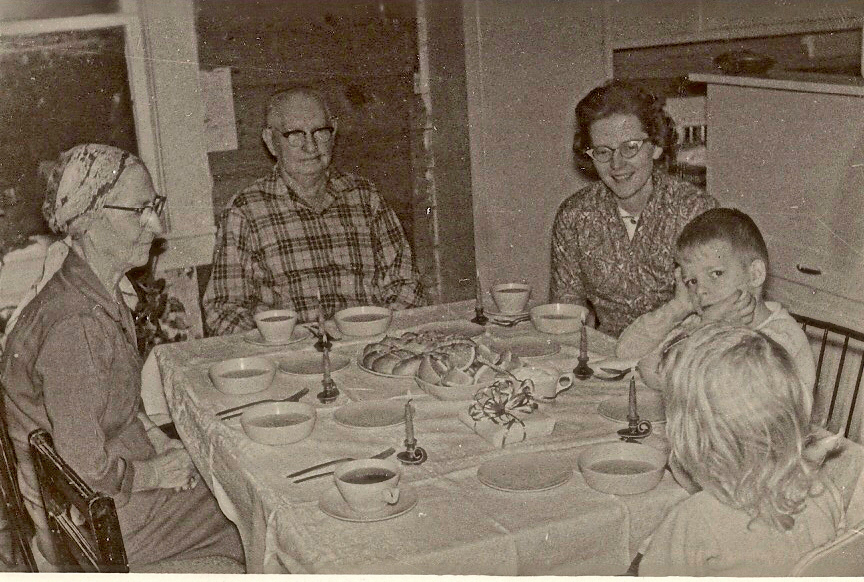
My grandmother, grandfather, mother, me, and my sister (I think). My dad was probably taking this picture.
From the Principal…
Some of my favorite memories revolve around Thanksgiving. I can still picture my grandfather as he looked up from a meal, patted his stomach, and said, “Best meal I ever had.” My mother recounts her resolve to become a better cook because of the constant praise and encouragement from her father-in-law. Whether a cool drink of water or a Christmas gift made by a grandchild, he always said a heart-felt thank you.
When I was a junior in high school my work and school schedule caused me to be at home for Thanksgiving while the rest of the family was out of town. I was to have Thanksgiving dinner with my grandfather in the nursing home. I visited him often but was not excited about having dinner there.
He had very limited speech because of a stroke, but as we sat quietly eating our Thanksgiving meal I began to think of all the gifts this great man had given me. He had taken me on long walks, shown me where old family historic places were, told me hunting stories, and taught me the names of plants and trees. I was overcome with a sense of thankfulness for his life and his influence. This quiet meal with my grandfather has become one of my favorite Thanksgiving memories.
Today I am thankful for my family and friends. I’m thankful for having meaningful work and great people to work with. I’m thankful for the children whose lives we can touch and make a positive difference. I hope this Thanksgiving will be a time of reflection and joy as we give thanks and make new memories.
News Alma Intermediate 1114 Open this link to read the newsletter.
El Dorado High School 40th Reunion: Progress, and Paths Traveled

Some things get better with age. Members of the 1974 senior class who visited El Dorado for their 40th reunion saw evidence of many changes. They were encouraged that so many changes were for the better. It was an honor to see the progress made in our little south Arkansas town, despite economic challenges and a reduction in population. The community has a treasure in El Dorado Public Schools.
Those who attended the tour of El Dorado High School were amazed. Alva Reibe, one of our classmates, is now the principal and gave us an excellent walk through the campus. The high school we attended was built in the 60s. This 2012 campus reflects the changes that have occurred over the years. The campus is secure, yet beautiful and inviting, and packed with new technology.

Walking toward the entrance to El Dorado High School
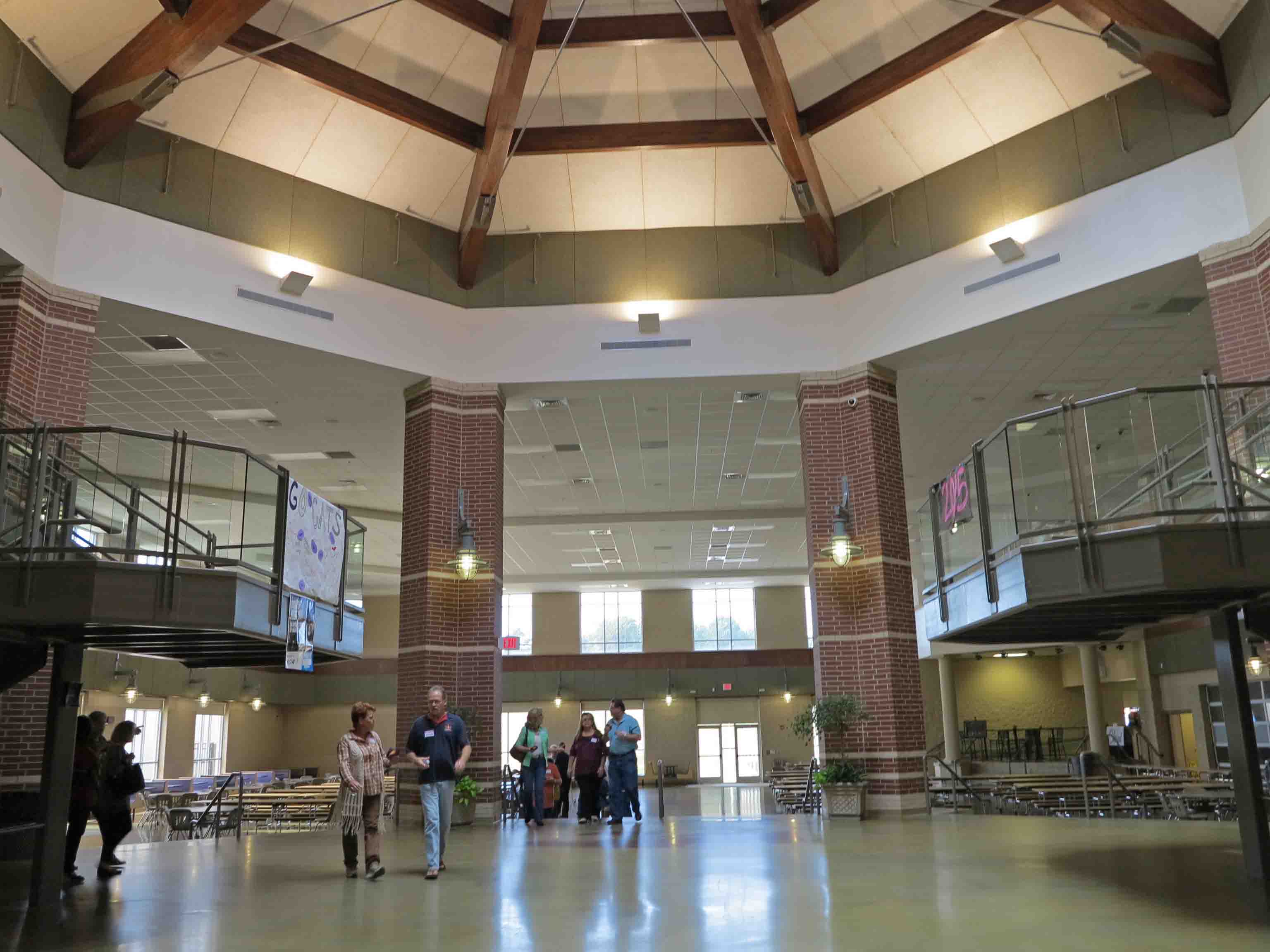
Entrance and lobby of El Dorado High School
As you arrive, there’s no doubt about where to enter. The entrance and lobby make you want to hang out and enjoy fellowship with others. This was also a good place to enjoy some Spud-nuts. If you’re not from El Dorado, you might not understand the significance of these little treats.

Alva Reibe addressing members of the 1974 senior class.
The tour took us down several hallways. I commented that it was like a mall, with wide, open hallways, and windows into classrooms. Alva explained that administrators can stand at hallway intersections between classes and cover all hallways to see that transitions are smooth and safe. They are also able to observe teachers watching transitions between classes.
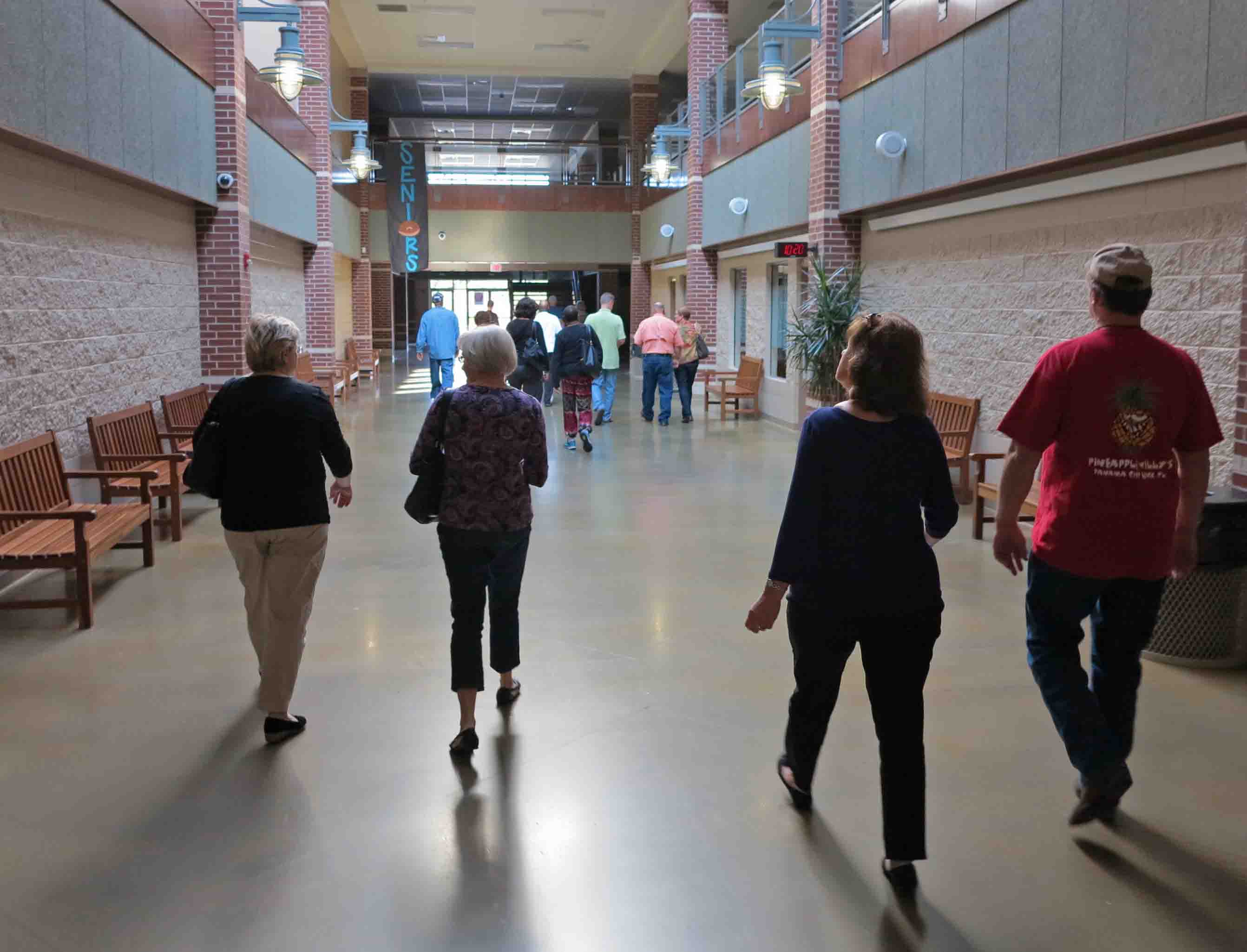

Many of us were excited to see new Fine Arts facilities. The band room was large and beautiful, with several smaller rehearsal areas. The theater was a great improvement over the little theater we remembered from our campus.

The new gym has seating on all sides which is a change from the one-sided seating we remembered from our campus. The gym featured large wooden beams and natural light, a testimony to the importance of the lumber industry in the El Dorado area.
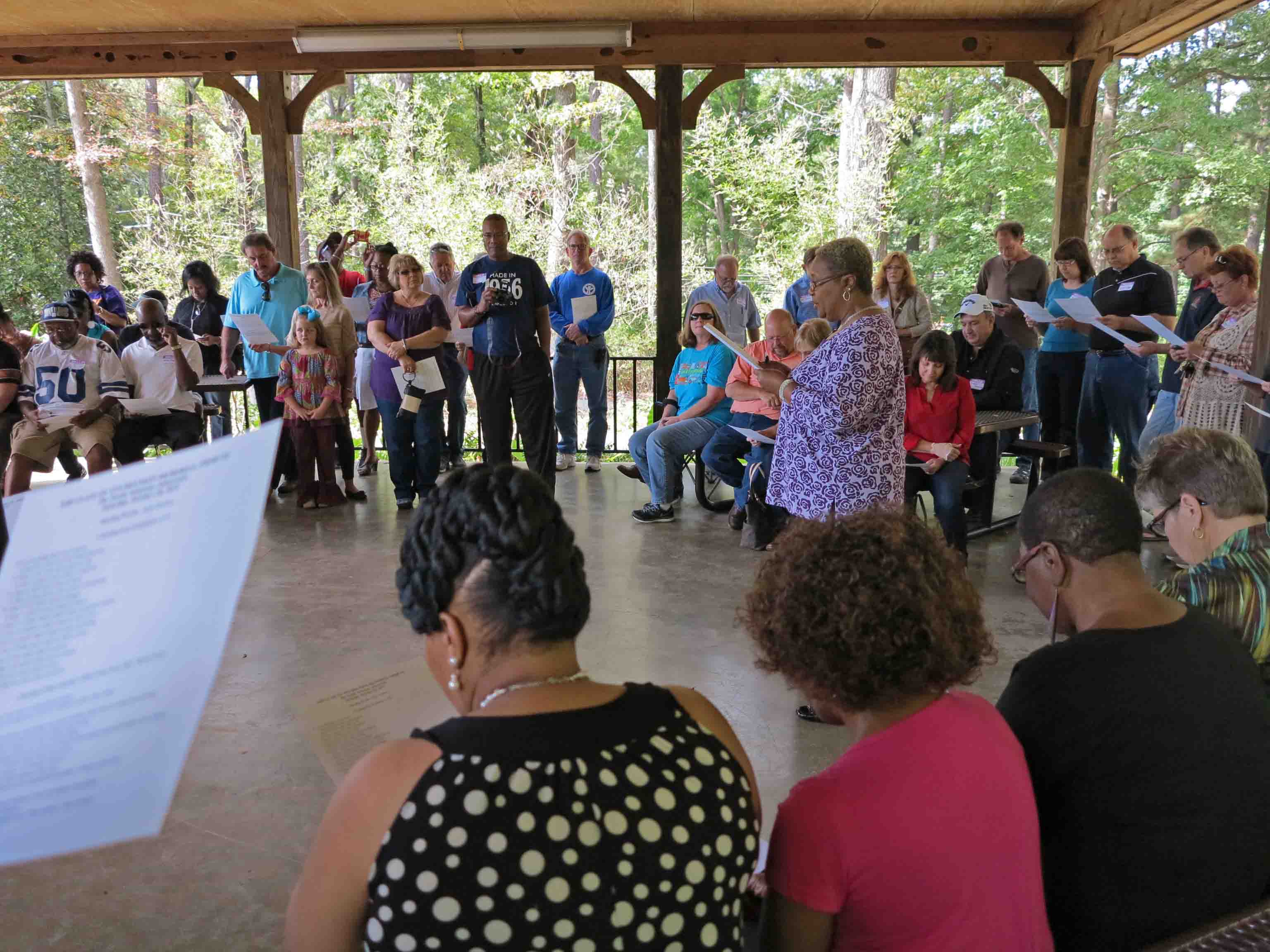
Sheila Primm reading, “When Great Trees Fall,” by Maya Angelou
A short program at the South Arkansas Arboretum was held to remember classmates who have died over the years. Of our class of 400-plus, about 60 had died. Beth Waldrop, classmate and now methodist minister, facilitated a short service assisted by classmates who sang, read poetry, and place small stones with classmates’ names at the fountain. It was a moving time of remembrance and thankfulness.
When Great Trees Fall by Maya Angelou’s
Reading by Sheila Primm
When great trees fall, rocks on distant hills shudder, Lions hunker down in tall grasses, and even elephants lumber after safety.
When great trees fall in forests, small things recoil into silence, their senses eroded beyond fear When great souls die, the air around us becomes light, rare, sterile. We breathe, briefly. Our eyes, briefly, see with a hurtful clarity. Our memory, suddenly sharpened, examines, gnaws on kind words unsaid, promised walks never taken. Great souls die and our reality, bound to them, takes leave of us.
Our souls, dependent upon their nurture, now shrink, wizened. Our minds, formed and informed by their radiance, fall away. We are not so much maddened as reduced to the unutterable ignorance of dark, cold caves.
And when great souls die, after a period peace blooms, lowly and always irregularly. Spaces fill with a kind of soothing electric vibration. Our senses, restored, never to be the same, whisper to us. They existed. They existed. We can be. Be, and be better. For they existed.

Placing stones as names were read and Don Parks sang Amazing Grace.
A highlight for me personally was hearing Rusty Meadows sing a little chorus he wrote related to the work he does in family counseling. He was hesitant about singing, but we were glad he did. Sometimes the strength of a song isn’t so much in the music as it is in the life behind the music.
As the placing of stones concluded, Don Parks filled the air with a beautiful rendition of Amazing Grace. We left thankful for renewed friendships, and thankful for our journeys thus far. Our paths often look crooked and confusing as we travel, but when we pause to glance back, the way seems to make sense. It sometimes seems to be exactly the path we should have taken.
I wish all the best to the class of ’74 and look forward to seeing you in five years.

Renewing relationships with former teachers.

Time for dancing and celebration.

After 40-years, these name badges came in handy. My parents just loved that hair style…
Link to the script for the memorial program: EHS 40th Reunion Memorial Service-script
What’s in a Name? A Principal’s Short History of School Improvement Planning in Arkansas
Disclaimer: The following is base on my own best recollection.
We’ve been down some interesting, and often wayward, school improvement paths in Arkansas. I recently came across a school improvement document written for my present school back in the early 1990s. It was called Comprehensive Outcomes Evaluation (COE). We had a similar plan where I was teaching in south Arkansas about that same time. It was nice and thick with a pretty cover. I should have held onto it for future reference and a few laughs. But, the thing is, it wasn’t funny because educators had invested time in this plan.
Research to support why you were doing what you were doing was not necessary, and results were not tracked. It was just a litany of things to do that MIGHT improve student learning in your school. Areas to improve included almost everything. There were goals written for literacy, math, and science, social studies, and school discipline. I’m not sure how the arts and physical education escaped being topics for improvement.
A few years later I became principal at Yocum Elementary School in El Dorado. Leading this school was a wonderful experience. After being there a few months, I unearthed their COE. I almost cried. It had lists of task in each content area involving all staff. I read it and then placed it on my shelf. I learned that my predecessor and one teacher had stayed in the office for a couple of weeks, writing that COE with no input from staff. I never referred to the document again, but harbored the hope that we would involve teachers in the development of our COE.

The last ACSIP I worked on with teachers at Yocum Elementary before moving to Alma Intermediate.
The name changed sometime in the late 1990s. The word “Outcomes” from COE became a politically loaded term. The new name was Arkansas Consolidated School Improvement Plan (ACSIP). Later, the term “Consolidated” acquired negative connotations due to controversial consolidation of smaller school districts, so the name was changed again to Arkansas Comprehensive School Improvement Plan (still ACSIP). Over time the ACSIP lived up to the term COMPREHENSIVE.
In the early 2000s, while attending the Arkansas Leadership Academy, I advocated in favor of the ACSIP. I argued that, if developed collaboratively, the ACSIP could function as a real improvement plan, influencing the work of the school. The leaders of this training believed that the ACSIP was becoming a compliance document and that there was a need for writing another REAL improvement plan with your staff. They were right. It didn’t take long for every piece of legislation to end with the phrase, “and this shall be documented in the schools’ ACSIP.”
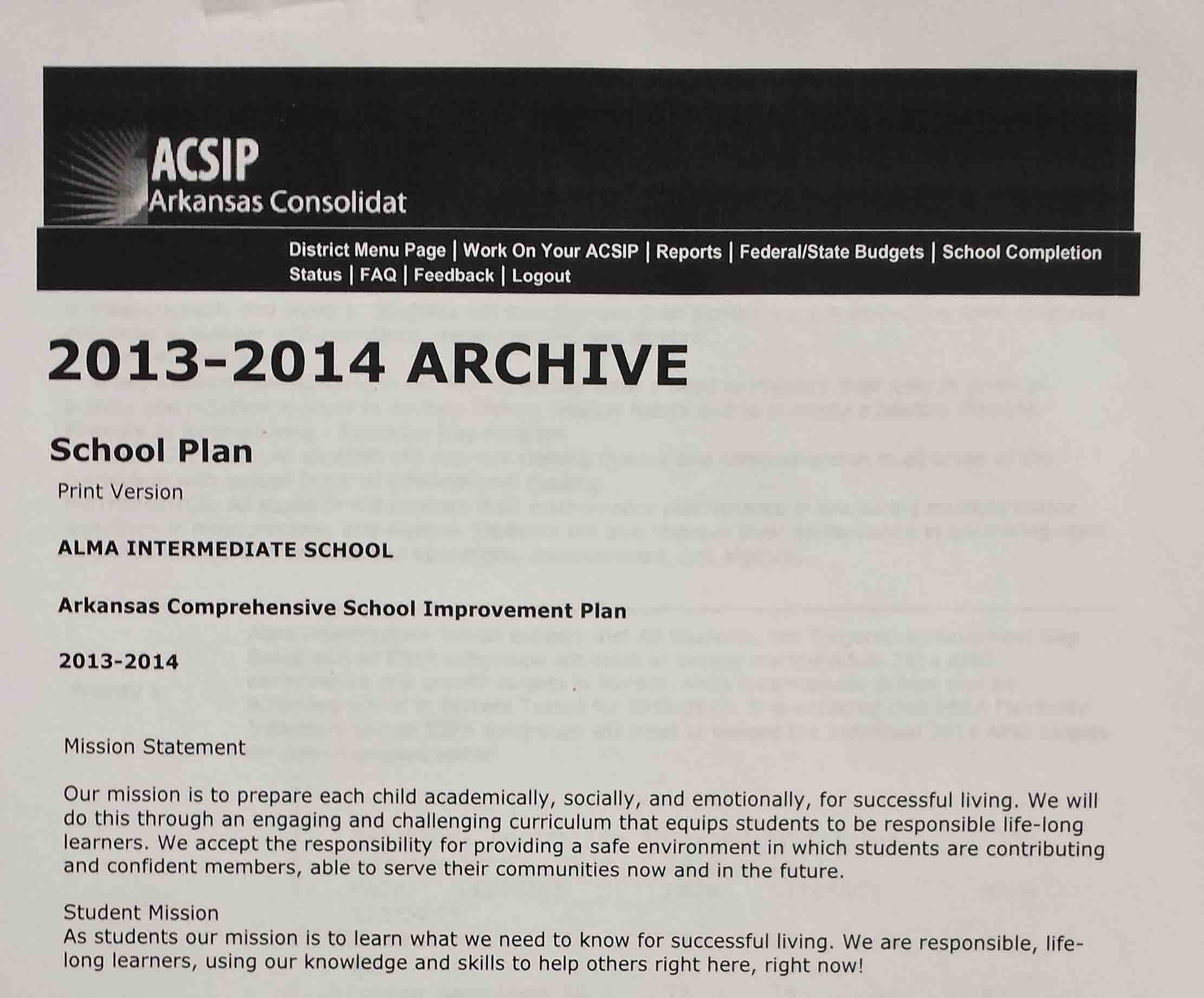
Our school improvement plan which included a wellness section an many prescribed items. The Mission Statement and portions of the plan were developed by our teachers.
What we ended up with was the humorous, yet tragic, spectacle of a Health and Wellness committee as part of the school improvement plan. The State Department of Education prescribed goals to improve student health and lower the body mass index of students (BMI). Thanks to state legislation, we had school improvement actions stating how many times per year we could offer students snacks in school. I support physical fitness (see my other blog) but do not think this has a place in the school improvement plan, unless a staff makes it their priority.
We’ve puttered along for several years now, watching our ACSIP swell in size and shrink in impact. Finally, we had a State Department of Education Commissioner and a couple of legislators who listened and realized that the ACSIP needed to change. We were so excited about this development that we gladly signed up to be a pilot school in the new program being used to enter school improvement goals and actions. I’ve continued to hold the belief, though sometimes fleeting, that it is possible to have a school improvement plan that truly influences the direction of the school and improves student learning.
This short history brings us to the present and our attendance of a day of training at the Convention Center in Fort Smith in September. We entered the room with our laptops in hand, looking forward to learning how to use the new web based program to document real school improvement planning in our school. At 1:15 p.m. we still had not opened the program together or gotten our hands into the real work. We were frustrated! What we endured that day was a remediation course in school improvement. I expressed my frustration in a letter. I was troubled that this opportunity to build on our enthusiasm was squandered.
Our district’s technology trainer worked with us later, accomplishing in 1.5 hours what was not accomplish in a whole day with the state training. We maintained our enthusiasm and are now on the path of possibly making the ACSIP a meaningful school improvement process for our school.
ACSIP still stands for Arkansas Comprehensive School Improvement Plan. I think the name should be changed to something like ARSIP for Arkansas Responsive School Improvement Plan. We should then rise up and say “NO!” when the inevitable additions begin to flow down from Little Rock. We must say, “We will NOT put that in our school improvement plan. It is a living document that we are revising based on best practices and the needs of our students, not what some external entity dictates.”
My hope is that we don’t end up adopting the name, “Arkansas Prescribed School Improvement Plan.” Our best defense against this is to become deeply engaged in making our school improvement plans real, while guarding against the incursion of distant forces who think they can best prescribe to the needs of our school.
I choose to be hopeful. It will be interesting to see where we go from here.
Art Travels
Reese Kennedy was my mother’s older brother. He was an artist. He was a complex, soft-spoken man, but there was a richness and generosity in that complexity. He was kind and gentle, and loved his family very much.
I’ve written the story of convincing Uncle Reese to draw a Texas Longhorn for me when I was five. What I didn’t tell was how that ink and chalk drawing later disappeared.
I assumed that it was lost or accidentally tossed when my parents moved several years after I graduated from college. I would think of it often, but eventually gave up on ever seeing it again. I was sad that this icon from childhood was lost and possibly destroyed.
While attending Reese’s funeral, I thought again about that drawing while hearing stories of those he influenced over the course of his life. Stories were shared of his work as an artist, teacher, father and friend. He had led a distinguished life personally and professionally. He was a founding member and first president of the Southwest Watercolor Society and taught art at Stephen F. Austin University prior to his retirement.
Several years later I was helping my parents clean Aunt Lucille’s home following her death in Nacogdoches, Texas. She and Reese were both highly respected watercolor artists.
While I was sorting through books, Reese’s son-in-law, Larry walked in and said, “Is this something that belongs to you?” He was holding the Texas Longhorn drawing. My parents theorized that they had given it to Reese years before, with the idea of having him make a frame for it in the frame shop of his Nacogdoches art gallery. It ended up in one of his collection folders and time passed by as it sat safely in his home.
I had the drawing framed, and it is now on display in a prominent place where I see it daily, thankful for this gift from the past. Knowing Reese, he would humbly say, “If I’d realized how special this drawing was going to be to you, I would have spent more time on it.” I would reply that in dealing with me at age five, he probably needed to make that longhorn appear quickly to hold my attention. It was beautiful to me then and still is today.

I posted the initial story of this drawing in January of 2014.
In July, I received the following email from the feedback page of my blog.
Jim
I think I have one of your uncle’s watercolors. The signature matches the one on your longhorn painting. The piece I have is a watercolor of a log cabin. Would you like me to email you a photo of it for you to see?
Scott Dressel-Martin
Scott
I would enjoy seeing a photo of the painting and forwarding it to Reese’s daughter. Reese was a founding member and first president of the Southwest Watercolor Society. He was a wonderful person.
Scott Dressel-Martin lives in Wheat Ridge, Colorado. After visiting his web site, I realized he was a gifted professional photographer. He once worked with one of my favorite nature photographers, Galen Rowell. I was delighted that my blog entry had led me to an artist who appreciated Reese’s art.
Then in August, the story continued.
Jim
At long last, here is a photo of the painting I think is by your uncle. Thank you for your patience. It’s about 20×24 framed, and it’s beautiful. I keep thinking it doesn’t match anything in my house, but it’s such a lovely painting I was never able to let it go.
Does this look like his work and signature to you?
I was given the painting by a friend in Vail about 20 years ago as he was moving out of town. I’ve enjoyed it ever since.
Cheers!
Scott,
That’s my Uncle Reese for sure! That is a beautiful painting. He once drove up scenic Hwy 7 through Arkansas, stopping to paint and photograph old barns and structures. Could have been that this old barn was from one of those trips. Or, it might have been a scene from East Texas. Thanks for sharing the photo.
The next message from Scott was a complete surprise.
Jim,
Now that we’ve determined that this is your Uncle’s work I’d like to make you an offer. If you’d be willing to pay for the shipping I’d be happy to give you the painting. I love the piece but it truly doesn’t fit in our home decor. It would make my wife and I very happy to know the work is being appreciated and cherished by someone that has a connection to it. It would feel like the piece is going home in a way.
Scott,
Wow! Must say you’ve brought a tear to my eye with your kind offer. I would be delighted to have this painting and would treasure it for years to come.
Just let me know the cost after you ship and I’ll gladly reimburse you to your Garland St. address. I will also make a donation to the David Kennedy Music Scholarship fund in appreciation for your gift to me. David, a gifted classical guitarist, was Reese’s son pursuing a doctorate in music performance from North Texas State University in the 1980s when he died in his early 30s. Reese’s daughter, Carol, has applied any sales of his paintings to the scholarship fund over the years.
Jim,
Excellent!! I will have the painting shipped in the next week and let you know when it’s on the way.
It is wonderful to know that we are playing a small part in helping the scholarship fund. Music and theater are important to us and helping students in need is always a worthy endeavor.
I can’t wait for you to have this painting!
Cheers!!
And so, this is how another painting by Reese Kennedy came into my possession. It is perfect for my office and even ties in with our school colors of green and gold. I look at this painting and think of Reese’s brushes shaping every inch as he sat behind his easel along Highway 7 or somewhere in an East Texas field.

Reese was an artist. He couldn’t help but paint, but I wonder if he had any inkling of the paths some of his art would travel? That one of his drawings would be “lost” then found and cherished years later. I think he would be pleased to know that his work would be treasured and shared for years into the future.

I enjoyed showing Reese’s painting to co-workers and sharing the story behind that big box in the office.

The painting was shipped with care. After seeing this photo, Carol (Reese’s daughter) said this is what Reese called called “ink and wash” technique — some drawing with india ink (often with a quill) and when the ink dried, he would add the watercolor washes.
Memorable Burger at Bailey’s
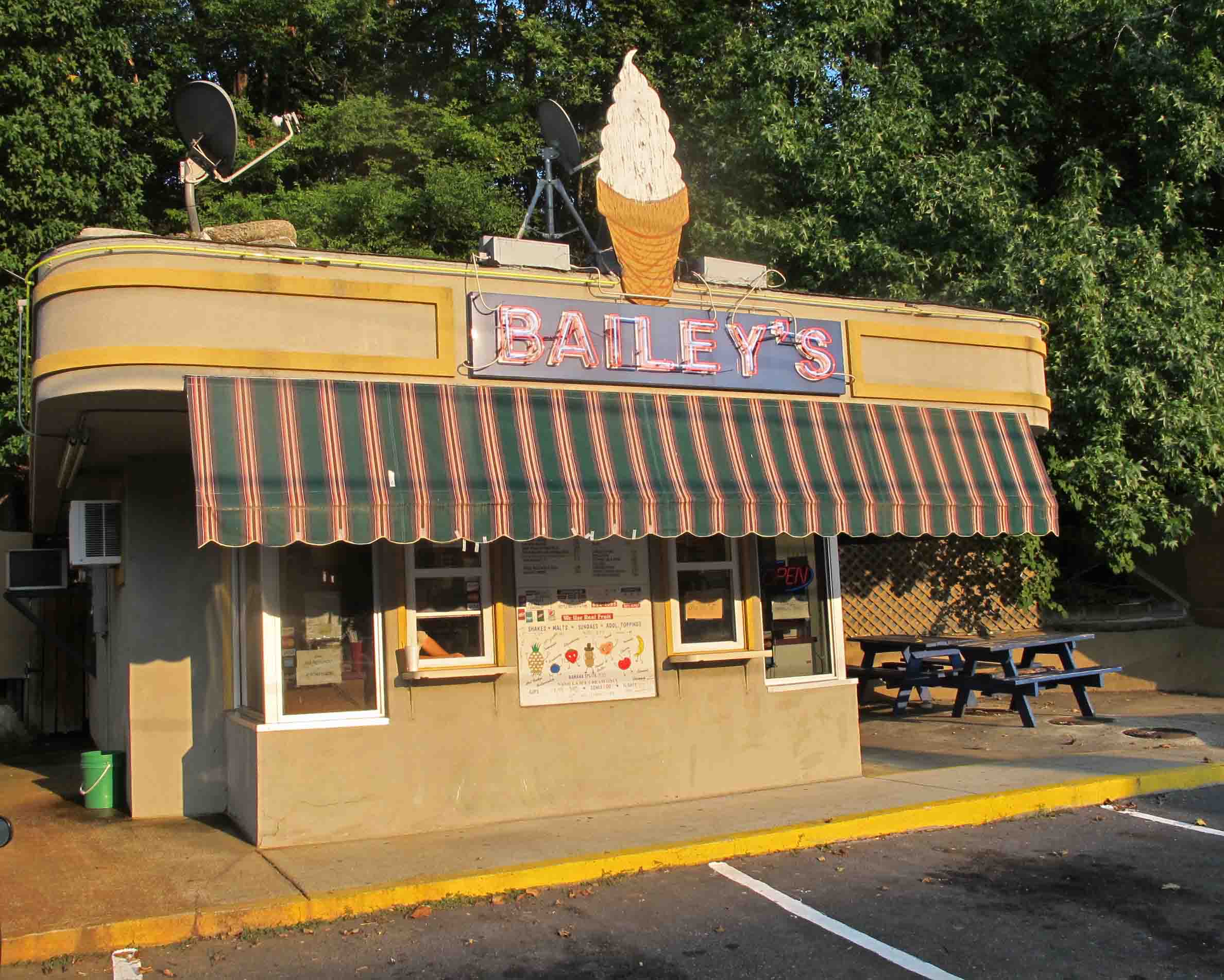
Recently I attended a school principals’ conference in Hot Springs. Heading home up Central Avenue, I saw Bailey’s Old Fashioned Hamburger and couldn’t resist a quick stop. I enjoyed visiting with the owner who had grown up in the area. He said Bailey’s was built in 1938, but my first memories went back to the 1980s when I attended an Arkansas Bandmasters’ Association conference just a few blocks away.
Following a day of workshops, Dr. Don Kramer, John Webb, and I walked up Central Ave. to Bailey’s. Dr. Kramer taught trumpet at Henderson State University. John was my supervising teacher during my internship. A highlight of Dr. Kramer’s career must have been teaching me in brass methods class. One day he looked kindly at me and sighed, “Thank goodness you play percussion.”
As we approached the front of Bailey’s, we gave a friendly greeting to the elderly lady behind the screen window. There was no response.
Dr. Kramer ordered something like a burger, fries, and a soft drink. The response to his order was a scowl and statement laced with profanity, asking why in the world anyone would order in such a way. Dr. Kramer laughed until he had tears. We were confused but laughed along. The lady flatly told Dr. Kramer what he should have ordered, and he agreed, still teary eyed.
John ordered next. His order drew the same response. He had not ordered as she thought he should have. By now we were all howling with laughter. John ordered as she dictated.
Having watched the two previous attempts, I had it figured out. I wanted something that was just slightly different than the special the lady was recommending. I received the same critical comments and gladly agreed to order as she indicated I should. Dr. Kramer and John enjoyed laughing at my ineffective attempt.
We sat at a picnic table and enjoyed our burger and fries. I don’t think we made any more attempts to converse with the elderly lady crouching behind the little screen window. The combination of her verbal attacks and Dr. Kramer’s response made for an entertaining dinner at Bailey’s and some special memories with good friends.
Don Kramer was a musical giant and John Webb was one of his best students Here’s a recording of Dr. Kramer performing with John Webb’s Camden Fairview High School in April of 1978. I was Dr. Kramer’s worst trumpet student in brass class, but he was kind and encouraged my drumming. I was honored to know him.
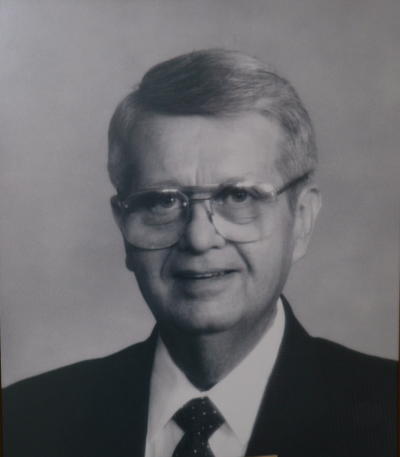
Dr. Don Kramer, Trumpet Professor at Henderson State University


 Principal Notes