Home » Uncategorized (Page 12)
Category Archives: Uncategorized
Wartime Communication: Then and Now
The following article was written by my mother, Elsie Warnock, and published in the El Dorado News Times on Veterans Day, 2013.
Wartime weapons may change but some things about war never change: death, destruction, loneliness, prayers for loved ones, killing of the innocent, grieving. Parents will always suffer anguish when their sons and daughters face battle and danger. Wives and husbands will always count the days days of separation. Children will always miss valuable time with an absent parent.
One thing hasn’t changed and will never change: the need to communicate between family and friends and the absent soldiers.

Lt. Jim Warnock, 1952
Jim Warnock, my husband, graduated from Ouachita College (now University) in May of 1950 as a new ROTC 2nd Lieutenant. The Korean War – or “Conflict” or “Police Action” or whatever neat word the Powers-That-Be can create to substitute for the accurate word WAR – broke out the next month so his immediate future was a given. During Jim’s service, our form of communication was letters, letters and more letters; a very rare phone call or two and one telegram to report his arrival time back in Arkansas.
The letters were sent airmail which was wonderful unless he was on a troop ship to Japan. Or unless the troops were changing locations. Or unless some person dropped the ball and didn’t move the mail in a timely manner.
Jim wrote in various letters, “Mail and the lack of it was a constant frustration. As much as I moved around on various field problems, I could go days without a letter. I remember one particular mailman. I don’t ordinarily shoot mail men but we had one in K Company that I was gunning for. One night he brought out the mail and said, ‘Oh, Lt. Warnock, I didn’t know you were going to be here. I have some mail for you back in the kitchen truck.’ If he hadn’t brought it that night, I planned an execution at dawn.
Receiving mail became a problem after Christmas because of the buildup of Christmas packages. The packages were delivered but the letters were held back until the packages could be delivered. So between the delay after we left Hokkaido and the Christmas rush of packages but no letters, mail was a longed for thing.
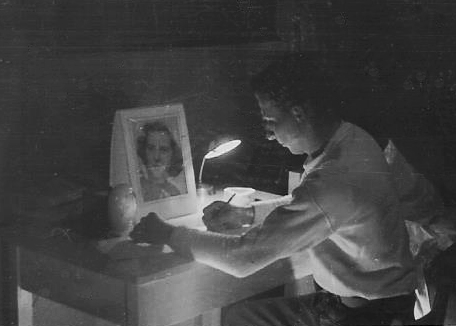
Writing letters to Elsie from Korea
Letter writing was a frequent pastime at night but lights out could come at any time. The lights were run off a little electric generator that would just quit whenever it took a notion. As I sat down to write one letter, (my roommate) Davis said, ‘Looks like we’ll have to make up a war story to write today ‘cause nothing happened here that sounds like war.’ I told him Elsie assured me that was the way she liked it.
With all my shifts in assignments I went thirteen days without mail and was going a little crazy. I told my sad story to the colonel. He was so impressed that he said he’d give me his jeep to get mail in but he didn’t furnish a driver so I drove a rough sixty miles to the front but I made it. The mail must go through! I picked up mail for several of the 45th personnel and headed back. It took my whole Sunday but the (getting thirteen letters ) reward was worth it.”

One home while in Korea
Long distance dealing with finances was an ongoing problem. Jim described one banking experience. “February of 1952 got me thinking about a first wedding anniversary that was coming on March 10. I wrote Martha Moreland, Elsie’s roommate at Ouachita, and asked her to arrange to send her (Elsie) some flowers since they were rather scarce on those Korean hills. I felt confident that she would have no trouble cashing the $10.00 check I sent her. After all, I had written it on a piece of paper I tore off a paper sack. She took it to the bank and it created no problem – some amusement – but no problem and Elsie got her surprise bouquet and even dinner at a restaurant with friends.”
On June 11, 1952, after fourteen months of living, breathing, and writing letters he was able to write this line: “I’m coming HOME.”
Now, fast forward to the current day. If we could have foreseen the changes that would occur in communication over the years, we would have thought we were watching one of those Buck Rogers space episodes from Saturdays at the movies.
Imagine! Someone can sit down in front of a screen, type a message, tap a few keys and your soldier is reading it. That adorable thing your young child just spoke (or did) can be sent immediately before you forgot that magic moment. During those Saturday matinees, we would have been wide-eyed if we had seen Buck Rogers pick up an object smaller than a deck of cards, press a few keys and instantly talk to someone near or far, for as long as needed. Family members today do it all the time without a second thought. That same small object can take a picture or video and send it around the world instantly.
If that isn’t remarkable enough, imagine sitting in front of your computer with a tiny camera attached and actually talking face to face with the person. Think of how many fathers and mothers get to see their young children when they take their first steps, or hear some of their first words. Fathers no longer must wait months or even years to see how their children have grown. They can be there on Christmas morning, or for that very special birthday party, or there to see the teenagers dressed up for the Prom.
In the 1950s, we could take a picture, get the roll of film developed and airmail the picture. Now, families can take a photograph and in a moment download it to a computer, even edit it to improve it, and send it by email within minutes.
Husbands and wives can now each keep up with finances with instant access to records. (I wonder if they ever argue over money long distance.) Gifts can be ordered online and shipped to the right address.
Whatever happened to the Telegraph? Jim sent one fateful telegram home after landing in Seattle on that August day in 1952 to report that he and his traveling buddy were catching a military flight going to Little Rock. There was just one problem: the telegram was delivered to Elsie’s college address in Arkadelphia. When the telegraph operator read the message to Elsie who was in Hot Springs, her remark was, “Oh, this is terrible.” When both of them calmed down, he from his dismay at the negative reaction from a war wife and she from her dismay to discover that her husband was headed to the wrong town, the operator explained that he had checked on the flight and that it would land in Little Rock and gave the time. The story had a complicated happy ending about 3:00 a.m. the next morning in Hot Springs after she and relatives drove to Little Rock to watch every passenger disembark except for two lieutenants who had been bumped from the flight at Fort Smith and would arrive later that day.
We never found out what that telegraph operator must have gone through to discover a Ouachita coed’s home phone number in Hot Springs – on a Sunday with the college offices closed, but he deserved a bonus big time for going that extra mile. What a marvel a cell phone would have been but who knew such a thing would ever exist.
Yes, indeed. War is hell. But modern technology can help loved ones stay connected in spite of separations that are such a challenging part of military service during war and peacetime as well.
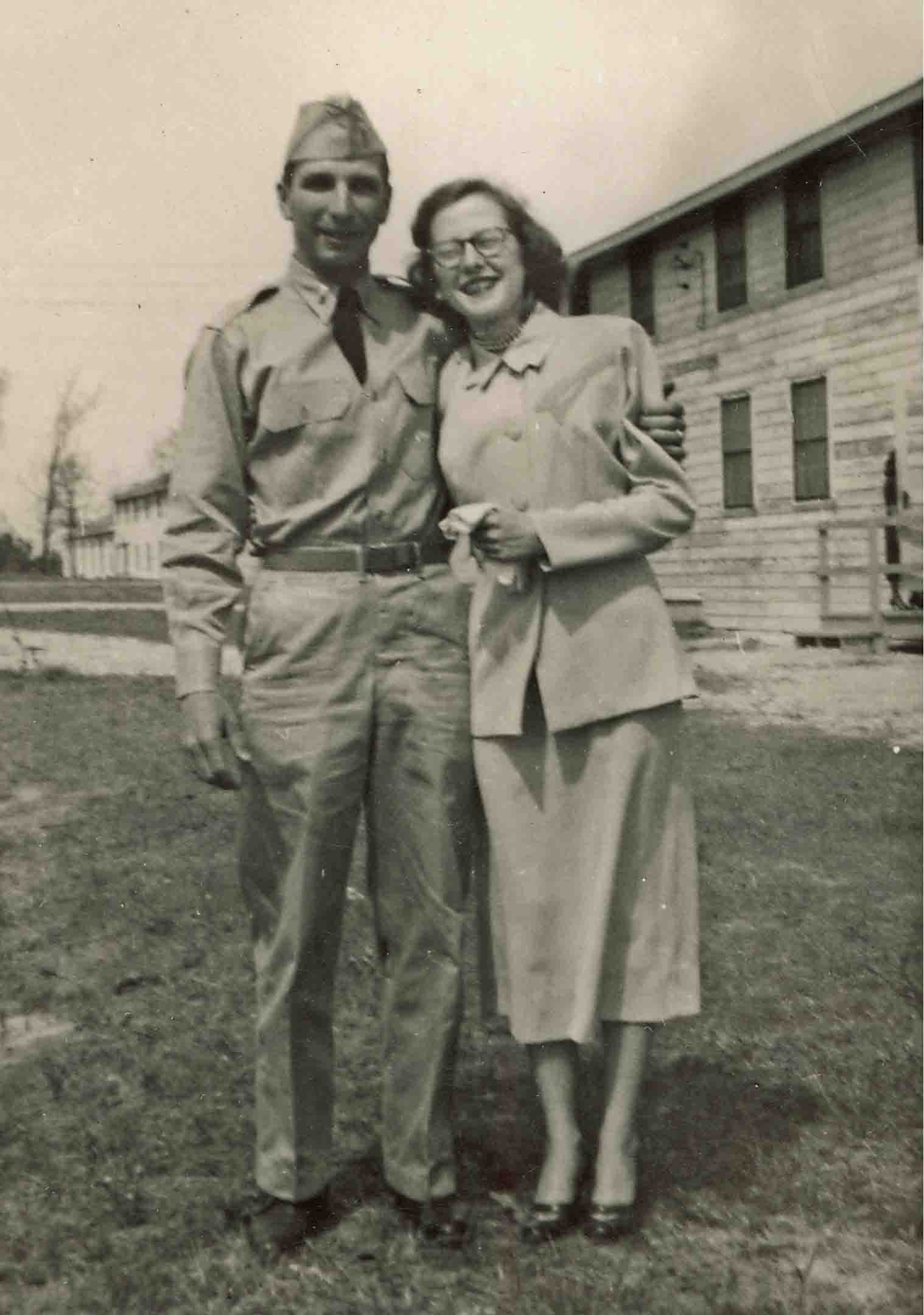
Jimmy and Elsie Warnock
A Practical Tool for Looking at Grade Retention
“I want Johnny retained, and that’s that!” Many of us in education have probably heard something similar from parents or a teacher. Unfortunately, we sometimes jump into retention as the answer when a more targeted and studied response would offer better results.
At Alma Intermediate School, we use the Light’s Retention Scale (LRS) as a tool to gather evidence for decisions about placement that might change the path of a child’s future. By completing the LRS, student age, learning difficulties, behavior, family characteristics, attendance, motivation, and other factors are part of the decision about retention. I should give full disclosure here, and say that I think retention is an ineffective practice because of the lack of supporting research. John Hattie’s work places it in the “reverse effects” range on effect size. “This is one of the few areas in education where it is difficult to find any studies with a positive effect, and the few that do exist still hover close to a zero effect.” (Hattie, p 97)
Here’s just one short example in which we used the Light’s Retention Scale to gain evidence to aid in the decision making process.
A nine year old student (we’ll call her Julie) moved into our school district two summers ago. The parents were unsure about Julie’s placement. They produced a letter from her previous school stating Julie was being retained in 2nd grade because she had “not mastered the skills necessary to move on to the next grade level.” The letter went on to say, “Once a child has moved on to the next grade level, he or she never again has the chance to ‘go back’ and learn the skills of the previous grade.”
In my experience, grade-level skills are not so specific, clearly defined, or easy to measure. Children do not always fit neatly into specific grade levels. Even as an adult, I’m continually “going back” and relearning things. Sometimes I learn things I missed or that became relevant to me later in life. The same thing happens with children.
Our first step was to work with the parents to fill out a LRS which takes about twenty minutes to complete. After conferencing together with the parents and looking at the interpretation of scoring, we made the joint decision that Julie should be promoted to the third grade.
As a third grader, we saw Julie engaged in learning and enjoying strong relationships with teachers and her peers. Teachers learned from their assessments that reading fluency was Julie’s main area of weakness. Julie responded to focused fluency instruction and scored Proficient in both Literacy and Math. She is now having a great fourth grade year.
I recently asked Julie how she thought things might have been different if she had repeated 2nd grade. She said, “I think I would have been stuck in a rut that I couldn’t get out of. Like I was stuck in 2nd grade but not knowing how to get to 3rd grade.” What I saw before me as we visited was a child now hopeful about the future and excited about learning.
The Light’s Retention Scale does not make students successful. Only good teaching can do that, but it does provide important evidence related to student placement when the possibility of retention is being considered. It can also be used by educators as a defense against knee-jerk efforts to retain students who are experiencing learning challenges. These challenges require the hard work of intense and prescriptive teaching rather than the simple repetition of the previous year’s instruction. Committed and innovative teachers, equipped with relevant evidence, can move students through learning difficulties along multiple paths toward success.
John Hattie, Visible Learning, Routledge publisher, 2009
Light’s Retention Scale, Academic Therapy Publication, 2006
Written for the Arkansas Association of Educational Administrators December Instructional Leader.

Bensberg’s Music Store and the Perfect Gift
Written for Mr. Tommy Bensberg on his 90th birthday.
When I got my first job as a band director in Harmony Grove Mr. and Mrs. Bensberg were some of my best supporters. I used to enjoy visiting their store in Camden, Arkansas, and am now amazed when I think of the time Mr. Bensberg would take to visit with a young upstart music teacher like me.
I already had a lot of respect for the Bensberg name because of my friendship with several Camden musicians during high school including David Garrison, Sherry Benton, Martha Jane Smith, Bruce Belin, and Danny Tate. We formed a little band called Spirit Wind. All of the voices were trained by Mrs. Bensberg and they could sing!
While teaching at Harmony Grove (outside of Camden) I got the idea that I wanted to learn to play the bass guitar. I rented one from Mr. Bensberg for about three months and then brought it back, realizing that I didn’t have the desire necessary to practice that instrument and learn how to teach band, too!
Toward the end of that year at Harmony Grove I had the good judgment to ask Becca O’Neal to marry me. She had come up through the Warren Band and Choir programs under Mary Lou and Curry Martin. I got the idea of getting Becca a piano as a wedding gift and called Mary Lou Martin for advice. I then went straight to Bensberg’s Music Store. Once I settled on a piano, I asked if my bass guitar rental might be applied toward the purchase and Mr. Bensberg kindly said he could do that.
The piano was delivered to my mobile home in Harmony Grove. I’m amazed that the truck didn’t sink in that Ouachita River-bottom soil out there. Needless to say, that piano was the classiest thing on the property. I covered it with a quilt and presented it to Becca before our wedding. I think she was surprised to see a brand new piano when I removed the quilt.
We still have that Baldwin upright piano and consider it a family treasure. Happy 90th Birthday Mr. Bensberg! Thank you for your years of service to the musicians and families of south Arkansas and thank you for being an encouraging friend to this young music teacher as he began his teaching career.

Our piano from Bensberg’s Music after 34 years.

Tom Bensberg greeting visitors at his 90th Birthday celebration.
Update April, 2021
Becca and I will celebrate our 42nd anniversary in June. When we had our piano of 42 years tuned recently, Becca found the note I gave her with the piano. We’re thankful for this musical instrument and the influence it has had on our family and home. Both of our daughters learned the fundamentals of music on that piano and I still enjoy hearing Becca play it often.
Becca found some photos of former students. The photo below is of Mary who was Becca’s piano student and later a trumpet player in my band. We’re still friends with Mary and have had the joy of watching her grow up and build her own family.

Maps
Written for the Arkansas Association of Educational Administrators’ newsletter, November, 2013
I have a bookshelf filled with maps, some of where I’ve been and some of where I want to go. Sometimes I’ll trace an imaginary path on a map trying to visualize the contour of the land or the view above treeline. Later, when I travel the actual trail, I’m always astonished by the beauty, realizing my imagination didn’t come close to seeing the magnitude of the place.

Santa Fe Baldy and Lake Katherine
On a second trip to Santa Fe Baldy in New Mexico a fellow principal and I looked at our map and saw a small mountain lake located just a couple of miles over a ridge from where we were camped. We decided to explore Lake Katherine the next day. What we found was a pristine snowmelt lake bordered by spruce forests and steep snow-covered rockslides. I carry memories of that beauty in my mind to this day.

Lake Katherine
Without our map we would have missed what became a highlight of our trip. Having a map opens new possibilities. If you can orient yourself and determine where you are, a map can help you find your way to some pretty neat places.
I recently visited our third grade classes over several days. I knew from their curriculum map that they were representing data so I had a preconceived idea of what I would see. The reality of the learning and engagement blew me away. Students were excited about the data they’d collected. They worked in teams, determining how best to represent their data to the rest of the class. Some used line plots or bar graphs while others chose to show their data with pictographs. The teachers provided sentence stems so students could practice using carefully crafted language to express their findings verbally to their classmates.
What I saw in those classrooms was evidence of teacher collaboration around a shared curriculum that had been developed from Common Core State Standards. I heard similar language and saw similar (not cookie cutter) approaches to teaching. Teachers were using formative assessment and curriculum maps to determine where students were and how to move forward. Best of all, students knew their locations and were excited about their future direction.
As educators we sometimes hear comments about how limiting required standards and curriculum maps are as if they stifle our creativity. These are not lockstep scripts for teachers to follow but outlines of instructional direction which expert teachers can use to “stay found” on a path of learning. Far from limiting our adventures in learning, deep knowledge of the curriculum opens possible side trails that might lead to significant learning for students based on their interests and skills. A good map gives us the confidence to explore levels of learning we might otherwise miss.
Enjoy your learning journey. Remember to pack your map.
Traveling Light
Written for the AAEA Newsletter for October, 2013
While hiking the Ozark Highlands Trail, my buddies and I came across a couple of college students. It was their first time on the trail and one said, “I’m carrying 60-pounds in this pack!” Surprised, I said, “Why?” He seemed a little confused by my response, and I then realized he was expecting me to be impressed but I felt only sympathy.
When we met these two guys on the next day, they were sprawled out in the middle of the trail totally exhausted. I casually mentioned that the forest road we were crossing went straight to Highway 7 where there was cell phone coverage. A few minutes later, I noticed them slumping down that road with their 60-pound packs, wisely cutting their trip short.
Hiking on, I began to think about some of my first outings when I carried about 45-pounds, equivalent to the World Book Encyclopedia volumes A-S. With experience, I found that some items were not essential or could be replaced with lighter items. Over time, my pack weight came down to 25-30 pounds depending on the season. My wife says my obsession with packing light saves money because when she suggests a new piece of equipment, I typically reply it wouldn’t be worth the added weight.

Four days of food and shelter in just under 30 pounds.
As an educator, I often feel like other people are trying to drop stuff in my pack, especially during legislative sessions. Successful organizations maintain dexterity and the ability to move fast, but our schools often stumble under the weight of requirements that can limit our ability to respond to the needs of students and teachers.
Sometimes, I spread out the items from my pack and try to eliminate what isn’t essential. I like Swiss Army knives and used to carry one. I found that a small single blade knife was all I needed and saved several ounces. It would be nice to have a complete set of cooking pots, but one small well-designed pot will work.
As my pack-weight came down my enjoyment went up. No longer walking head down looking at the trail in front of my nose, I could hold my head up and see the beauty around me. I became more responsive to changes in the terrain and could see land features that helped me keep my bearings. Challenges that would have been insurmountable with a 45-pound load were easily climbed with the lighter pack.
As educators, we have a responsibility to scrutinize everything we do in our schools to be sure our time and resources are benefiting students. Ounces add up. There may be practices we can drop or change. Some essential tasks might be better placed in someone else’s pack. We might develop leadership capacity in our schools by thoughtfully placing important items with others to complement their talents and strengths. “We’ve always done it this way” is not a good rationale for loading a pack or setting priorities.
Earl Schafer, the first person to thru-hike the 2000-mile Appalachian Trail said, “Carry as little as possible but choose that little with care.” It’s important that we, as educators, have the flexibility to pack what we need for our particular schools while avoiding having outside forces load us up with weight that doesn’t serve the needs of our students and teachers. Our involvement in the AAEA is critical to this process. The AAEA’s strength comes from the involvement and collective voices of its membership.
Bring legislators and community leaders into your school. Share your vision, your strengths, and the needs of your students. Share your expertise and make yourself a resource for state leaders as they grapple with matters impacting schools. Use the AAEA to stay informed, and be ready to speak up on issues when needed. These actions will help ensure that we carry what we need while traveling light enough to move our students, teachers, and schools toward success.

View from mile 43 of the Ozark Highlands Trail
Paying it Forward
Written for the Arkansas Association of Educational Administrators newsletter, September, 2013.
After his first year of college my father was back in his hometown of Smackover looking for work. He wouldn’t be able to continue his education because money for tuition simply was not there. Two local men learned of his situation and contacted my grandfather. They told him to send his son right back to school because his tuition had been covered for the next year. They asked my father not to repay them but to “pass it on.”
My father went on to finish college with a degree in science while working campus and summer jobs and qualifying for scholarships. His career path eventually led to his directing pollution control in oil and chemical plants. By the time I entered college my dad operated a water treatment plant for an oil refinery. I saw dark, sludgy liquids entering this plant only to come the other side as crystal clear water. He enjoyed his job because it blended his love of science and appreciation for the natural world. He was able to do this work because of his education. While he may have doubted the wisdom of my decision to pursue a degree in music, he saw to it that I went to college.
I admire people who can say “I’m a self-made man,” but in my case it just wouldn’t be accurate. The truth is that my way has been opened by the kindness and generosity of others. I was once trying to express to my father that there’s no way to repay your parents for all that they do in your lifetime. He said the only repayment he wanted was to see his gifts passed on to his grandchildren.
Some of the most significant gifts from my parents have been time, unconditional love, and an education. There was never a question if my father would attend a ballgame, concert, or school event. I never once wondered if he would come home after work. His commitment to my mother and his children was unconditional. He had been given some opportunities and would see to it that those gifts were passed on to his children. The best I can do is say “thank you” and work to pass those gifts on to my children and the children I’m privileged to work with at school.
In our rush-a-day work as educators it might do us good to pause and reflect on the gifts we’ve been given. Who has helped us along the way by giving encouragement or supporting our growth? How have we worked to increase the value of these gifts and paid them forward? Whose professional growth are we investing in and how are we encouraging others (children and adults) on their paths of learning?
I never met either of the men who covered my father’s college tuition. Many years later I told the story to one of their granddaughters and learned that her grandfather was a giving person who helped a number of young people in his community in similar ways. He would have been pleased to learn that his gift of educational opportunity had been passed down to his great-granddaughter’s school principal.
Some gifts have a way of increasing in value over time. Like that gift of college tuition for my father so many years ago, our investments in others will have positive effects for years and possibly generations to come.
Note: Below is a picture of my dad (blue hardhat) and description of work he was involved with in water conservation.


My father writing a letter to my mother in the early 1950s from Korea.

Climbing a mountain in Mexico with my dad in the late 90s.

My dad in 2013, at 85, visiting his hometown of Smackover.
The Worst School Year Ever!
The worst school year ever! That’s how I remember my last year in elementary school. I spent a large amount of time digging ruts in the pencil holder of my desk. I learned that by sharpening my pencil and applying just the right amount of pressure, I could make a rut deeper without breaking the point. I was experiencing a caustic classroom environment and a burned out teacher. I’ll call her Ms. S.
I stayed out of Ms. S’s line of sight as much as possible but a classmate named Ricky didn’t have that luxury. He was a tall, lanky, good-looking kid. He was outgoing, verbally clever, and an artist. None of these qualities were valued in this classroom and he quickly became the teacher’s “whipping boy.” If a rule was violated or there was a disruption, it was assumed that Ricky had a part in it.
There is one person I have no memory of from that year…the principal. I never saw the principal in our classroom. I can’t remember who the principal was or what she looked like. I wonder if she had any idea of how we were suffering. If so, was she afraid to confront bad practices or overwhelmed with other duties? Did she hope to address instructional issues when she found the time?
How might Ricky’s life have been different if his artistic abilities had been valued and his verbal cleverness developed? He might have been the team member everyone wanted as we did collaborative projects but he had little value when it came to completing mind-numbing worksheets. In his early 30s, Ricky died of a lethal combination of drugs and alcohol. I’m not saying that his year with Ms. S was the reason for this but I do know that caring teachers can change the trajectory of a child’s life.
If she were still alive, Ms. S might be surprised to hear that I learned several lessons from her that impact my professional practice today. I learned that teachers have the most powerful influence (positive or negative) on student learning. I learned how important it is to visit classrooms and assess the culture and quality of interactions between teachers and students. I learned that it’s crucial to let students, teachers, and parents know my beliefs about teaching and learning. I also learned to watch for students like Ricky to see if their talents are valued and allowed to flourish.
A few months ago I was going through some old photographs at my parents’ home and came across the class photo from that year. I was shocked at the appearance of Ms. S. I remembered her as being ugly but she was actually very attractive. We were all sitting at our desks with artificial smiles pasted across our faces. I wondered how our lives might have been improved if the principal had been in the classroom often? How might Ms. S’s life improved if she had been challenged to do better and involved in professional learning with other teachers? It was a sad year in terms of learning and building relationships. More tragic is the collective impact of the many years that these bad practices were allowed to continue?
Thankfully teachers like Ms. S are uncommon. The majority of our teachers want to do the best they can for kids. Our responsibility as school leaders is to see to it that teachers have the resources needed and the professional knowledge and skills necessary to be successful in their work. When teachers are doing their best work, classrooms become joyful places where the paths of children’s lives are changed in profound and positive ways, impacting families, communities, and our nation for years to come.
Written for the Arkansas Association of Educational Administrators Newsletter for August, 2013
Evaluation Leads to New Learning

Portion of my 2-page principal evaluation instrument from the mid-1990s
Ever had a sinking feeling in your stomach while meeting with a supervisor? I had only been a principal for a couple of years and it was time for me to meet with my then superintendent, Mr. Bob Watson. He spent what felt like two hours working through an evaluation instrument using a 1-7 point scoring scale with 7 as the highest.
I was scoring fairly high on a number of areas and was feeling pretty good until he got to instructional topics. Those scores were lower. Mr. Watson gave good explanations of the instructional leadership needed. He must have seen the despair in my face because he expressed confidence that I would be able to focus on instruction and make it better.
And focus I did! I became obsessive about teaching and learning. I visited with and observed teachers who were masterful in their craft and tried to determine what made them successful. I found myself drawn to principals and school leaders who were focused on instruction. I visited some of their schools and copied their practices as best I could. I started spending lots of time in classrooms.
My reading habits changed as I became more interested in teaching strategies. My secretary at the time often laughed at the titles of my book purchases when they shipped into the office. She thought they must be very boring. It wasn’t long before I heard her telling parents on the phone how important it was to be on time because of missed instruction. My focus on instruction was contagious and was becoming a priority for teachers and even our secretary.
I had a new purpose for my involvement in professional organizations and I eliminated those that didn’t further growth in understanding of teaching and learning. The AAEA (Arkansas Association of Educational Administrators) became a hub for my professional learning. Those were fascinating times of discovery. This often bumpy and uphill path of learning continues through the present but it all goes back to that very difficult conversation my superintendent had with me about my need to improve as an instructional leader.
I recently pulled that early evaluation from my file and was astonished to learn that I hadn’t accurately remembered my scores. As I looked at the form my superintendent held that day I realized that the scores were not nearly as important as the conversation and the on-going support I received to pursue my learning and improve my practice as a principal.
Fast forward a few years and we are now scoring lessons observed with detailed rubrics describing various levels of practice. The rubrics for teachers and administrators are challenging but clear and add observable evidence to levels of performance.
If implemented in an environment of trust, these new methods of evaluation hold the possibility of being catalysts for improving instruction and school leadership. Professional learning and trusting relationships are the essential ingredients. While the scores do matter, the conversations and relationships are where real improvements in practice occur.
On a personal note: Thank you to Bob Watson for being willing to have that “courageous conversation” with me so many years ago. You set me on a positive path of learning that I still find challenging and exciting.

Portion of the new 19-page principal evaluation instrument currently being piloted.
Written for the Arkansas Association of Educational Administrators Newsletter, July 2013
My Father’s Tools (Father’s Day Letter)

Daddy,
Here are a few tools that you’ve shared with me over the years. I’ve tried to describe some lessons you taught with these tools….metaphorically that is. Normally I would be sure to put your tools back where I found them but I’ll hang onto these and pass some along to your grandchildren and the kids I work with at school.
Level – Approach challenges without flying off the handle. Maintain a personal balance in life. Things tend to be interrelated. If something is out of level in one spot, it’s probably wrong all over.
Hammer – Take aim and hit a nail carefully while avoiding damage to everything around it. Be careful when and where you use force or authority.
Pliers – Get a firm grip on challenges that come along. Try to understand an issue before you rush in to fix problems for others. It’s easy to get carried away and bend things out of whack. If you do need to make adjustments, do so with care.
Saw – Take time to get a sharp blade and take good measurements before you start hacking away at things. It’s easy to damage others if you go sawing away indiscriminately.
Loppers – When in doubt, thin things out. Life can get pretty cluttered with activities. Trim things out that are not working and make more space for good activities to thrive. If something doesn’t improve your life and the life of those around you, lop it out and thrown it on the burn pile.
Ruler – Take careful and accurate measure of yourself but don’t be too strict in measuring others. Avoid comparing yourself to others and realize that all people are of equal measure in the sight of God.
You have always taken accurate measurements and used tools carefully so that things fit together and are made better. Some people would use these same tools to cut down or injure others. While none of us use these tools perfectly, you’ve set the example of building others up and making the world a better place.
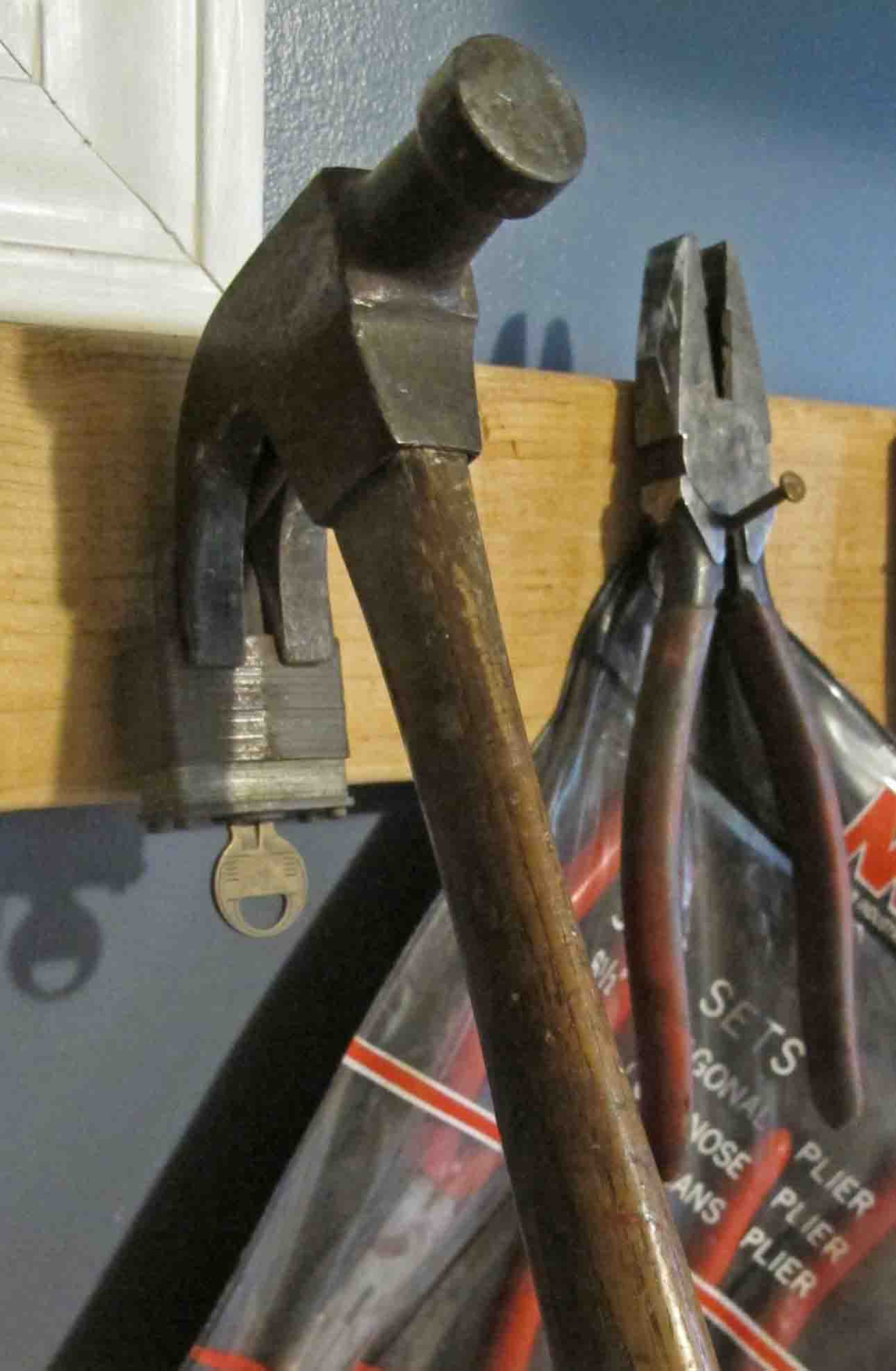
My dad’s hammer and pliers
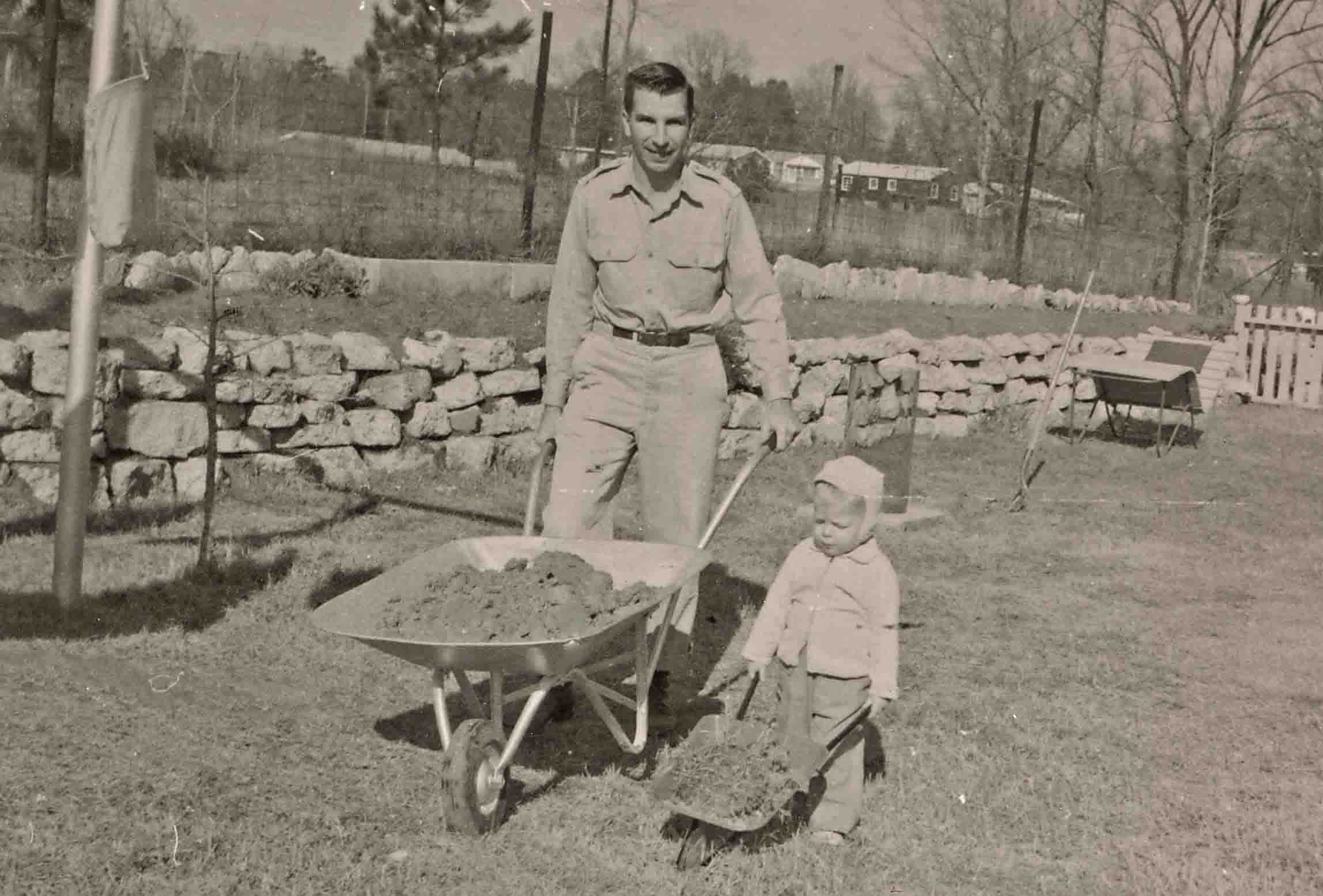
This is me trying to help my dad.
Poetry Slam Builds Enthusiasm and Courage for Writing
Imagine fifth grade students filled with excitement about writing two weeks after state testing? The Fifth Grade Poetry Slam at Alma Intermediate School builds enthusiasm for writing and adds a new instructional focus at a time of the year which might easily suffer from an emotional dip. “The experience was awesome! Reading in front of everyone got my spine a-tingling,” said one fifth grader. The poetry workshop is funded through the Arkansas Arts Council Mini Grant Program.

Clayton Scott leading a poetry session.
Nationally recognized guest poet, Clayton Scott, spent one week working with fifth graders in poetry sessions and taking students to the next level in their expressive writing. Mr. Scott met with all 260 fifth grade students each day. More than 1,200 poems were written by students during the week. Scott taught a variety of poetry styles and techniques along with creative tools that help even the most reluctant writers engage in the process.
A major focus of the week was encouraging students to “confront their inner chicken.” Students were challenged to stand up and speak out as they wrote and shared their poems. “I liked writing my poems and learned that fear shouldn’t keep you from doing something. I learned to confront my inner chicken and how to write better poetry,” said one typically reserved fifth grader.

Mr. Scott used an eagle graphic to represent a balanced approach to writing. For students’ writing to “soar” it takes a balanced effort by both wings. One wing contains the mechanics of good writing. Mr. Scott doesn’t dwell on these elements because they should be in place and are accomplished in editing. He places great emphasis on the creative wing which contains sensory imagery, power words, simile, metaphor, and many more. According to one student, “The experience was awesome. I learned how to use expressive language in all of my writing.”
Students had writing assignments each night based on poetry techniques taught that day. As students shared their poems the following day, Mr. Scott coached students on speech, delivery, and expressive reading.
The week culminated in a Poetry Slam open to the public. Finalists from every class were in competition on the final afternoon. Students were selected to act as judges for the Poetry Slam. Students were designated as masters of ceremony and filled other duties for the event which gave a strong sense of student ownership.

Student performing his poem at the slam.
A total of twenty-six finalists performed in the Poetry Slam along with Clayton Scott. Five students were selected as overall trophy winners. It was noted that some students who had not exhibited outstanding writing in the past came to the forefront in the poetry competition. It was a great chance for students to celebrate the successes of their peers. One finalist said, “At the poetry workshop I learned that you can have courage and express the stories of your life through poetry.”
Courage and creativity are exactly what our children need! Alma Intermediate School has found that poetry is a tool for helping students acquire both of these qualities.

Clayton Scott, guest poet, reminding students to confront and defeat their “inner chicken.”
 Principal Notes