Home » Uncategorized
Category Archives: Uncategorized
Sandwich Prayers
Volunteers at Sack Lunch make about fifty sandwiches at a time by spreading bread over a long make-table. Need a hundred sandwiches? Do two rotations. Pretty simple.
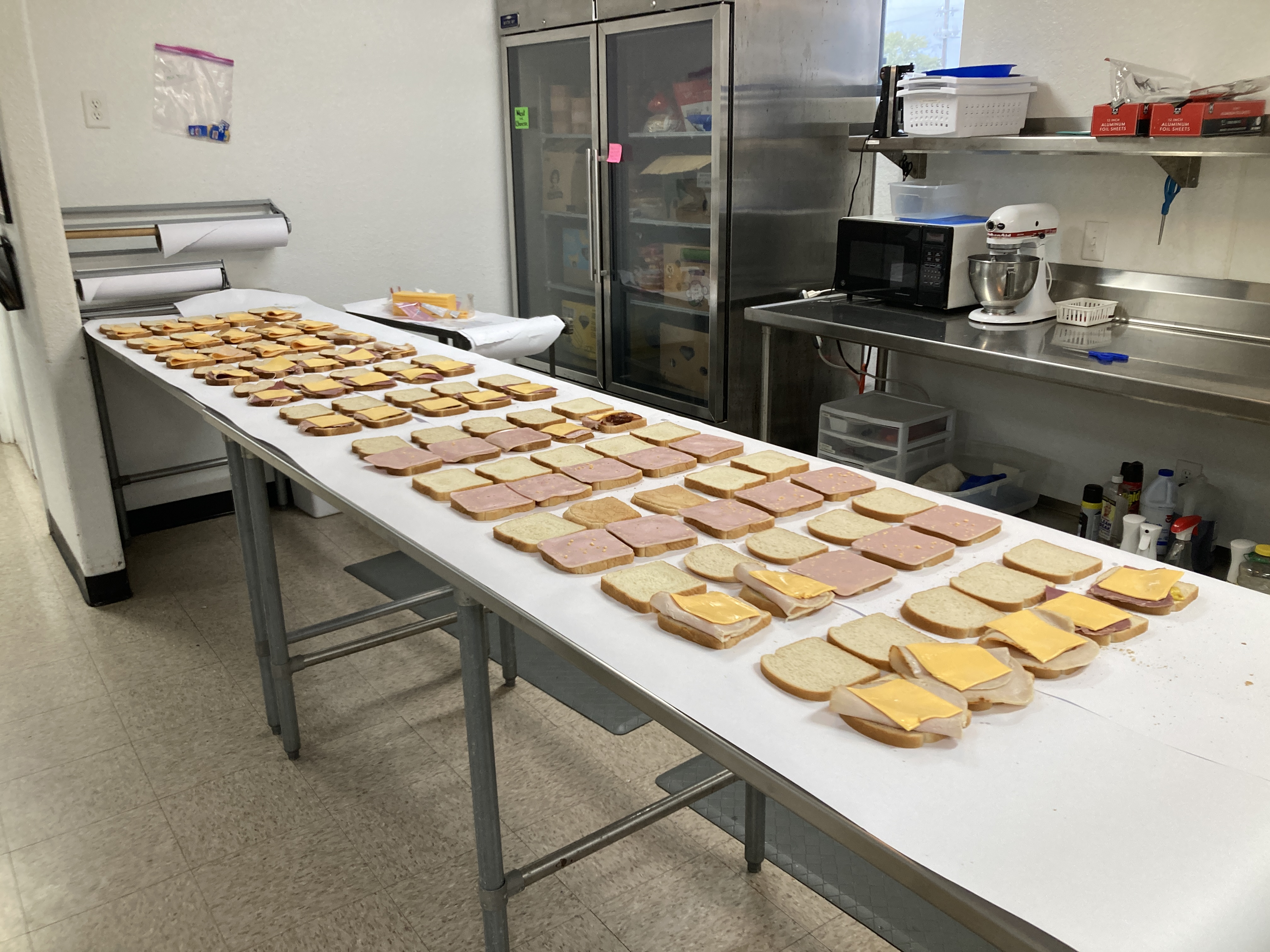
This morning’s sandwiches were ham and cheese. My favorite part is the last step when you wrap sandwiches in thin aluminum foil squares. It’s a simple, relaxing task. I thought of a song by Carrie Newcomer in which she reviews tasks from a typical day and how they can become holy. The lyric, “folding sheets like folding hands / to pray as only laundry can,” reminded me of wrapping sandwiches.

So, as I folded the squares of tin foil, I found myself saying a short prayer for whoever might receive each sandwich. May the hands that receive this gain strength and sense the love of Christ.
Simply by a whispered prayer, wrapping sandwiches at Sack Lunch became a meaningful time of worship for which I’m thankful.
Later my wife, Becca, assembled sack lunches that we passed along to our guests. As guests expressed thanks for their meals, I thought of the sandwich-wrapping prayer and began to better understand that these men, women, and children were brothers and sisters created in the image of God. In their receiving they were giving me a blessing. One long-time volunteer said, “In serving those in need, both the server and those being served are blessed.”

You may donate to Sack Lunch at this link, scrolling down to the Sack Lunch category. The need in our community is great. If you or someone you know is in need, stop in for a sack breakfast or lunch at 317 North F Street, Fort Smith, AR. Sack Lunch volunteers come from all walks of life and represent a variety of area churches and organizations.
Here’s a link to Carrie Newcomer’s song that inspired the sandwich-wrapping prayer…
Collect for Sack Lunch: O God, you teach us that Christ might be found in those who hunger and thirst. Help us to see your divinity in all people, especially those in need. Thank you for the blessings we receive in giving and help us be mindful that small acts of service may become acts of worship and thanksgiving.
Crawford County Retired Teachers Programs for 2025-26
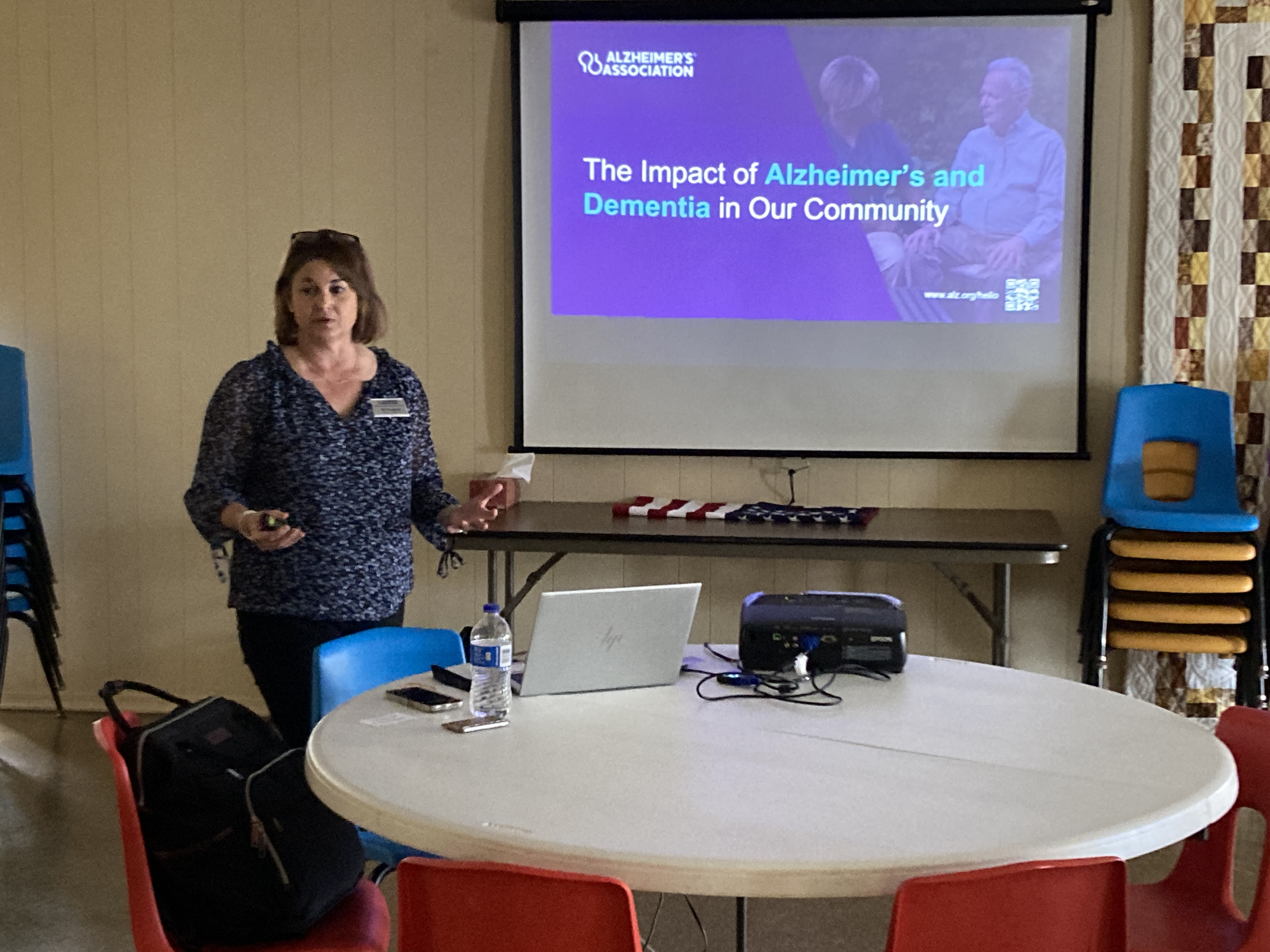
We’re excited about the programs we have lined up for this year. It’s fun to build relationships with retired teachers in our region and to continue learning about our schools and communities. Below is a list of our programs scheduled for this year. Photos below are from Jill Thompson’s excellent Oct. 8 program. This post is intended for the October 23 retired teachers’ session on programing.
Thursday September 11th we will meet in Fort Smith with Fort Smith Retired Teachers
Wednesday October 8th Jill Thompson jithompson@alz.org Program Director for the Alzheimer’s Association here in Arkansas.
Wednesday November 12th Mike McSpadden to discuss his book, Only One Airedale: An Integration Story
Wednesday December 10th (no presenter needed)
Wednesday March 11, 2026 Alma Agri program – Kisia Holland & Grace Hewat / Location: Alma High School Agri Building
Wednesday April 8, 2026 Monarch 61 Project – Wellness info@monarch61.com Nicole Walton, Executive Director / Location: 105 N 28th St. Suite D, Van Buren, AR 72956
Wednesday May 13, 2026 Current trends in assessment – Jami Ann Balkman, Alma School District
Recommendations for planning and scheduling programs:
- Schedule far in advance
- Make a letter that includes details of the flow of your meetings and then customize it based on who you’re contacting.
- Time:
- Topic:
- Audience:
- Meal schedule and presentation length.
- Determine logistics and tech needs.


Still Learning to Read
According to a September 2, 2025 article in the Arkansas Democrat-Gazette, the Arkansas commissioner of education said that as students move from third to fourth grade they move from “learning to read” to “reading to learn.”
I disagree. This often-repeated simplistic statement about reading doesn’t describe the complexity of young brains (or old) gleaning information from text. We are always reading to learn, and we are always learning to read.
When children open books before being able to decode the words they’re reading to learn, gathering information from text and illustrations. As an adult, when I’m faced with new types of information or unfamiliar concepts, I’m still learning to read. I’m adding new vocabulary. I’m sounding out words or looking up definitions of unfamiliar words.
We never stop learning to read and our commissioner of education should deepen legislators’ understanding of education rather than reinforce tired old education clichés.
Senate Bill 433…Whose Religion?

The recent passing of Senate Bill 433 brought up a memory from the past. On the morning after September 11, 2001, I remember saying the pledge of allegiance and hearing voices crack including mine. Then came the moment of silence. It was meaningful and I understood that some children cried softly. If a verbal prayer had been led by someone in authority, that moment would have been lost. Religion wasn’t forced, but it was allowed. That’s as it should be in the United States. If a child wants to bring his Bible (or another sacred scripture) to school, or pray quietly, that’s permitted in public schools.
Senate Bill 433 requires the display of our National Motto (In God We Trust) and The Ten Commandments in all Arkansas public school classrooms. This text must be on a “durable poster.” The motto poster must be “at least 11×14 inches.” The Ten Commandments must be displayed on a poster or in a frame of “at least 16×20 inches.” The specifics of size and font size seemed a little over the top but I’m sure they worried that some would place the ten commandments on a post-it note. Then the law appears to require that the text be displayed in the King James Version, a translation that many readers (including me) avoid. The law specifies “the Ten Commandments shall read as follows:”
“The Ten Commandments
I am the Lord thy God.
Thou shalt have no other gods before me.
Thou shalt not make to thyself any graven images.
Thou shalt not take the Name of the Lord thy God in vain.
Remember the Sabbath day, to keep it holy.
Honor thy father and thy mother, that thy days may be long upon the land
which the Lord thy God giveth thee.
Thou shalt not kill.
Thou shalt not commit adultery.
Thou shalt not steal.
Thou shalt not bear false witness against thy neighbor.
Thou shalt not covet thy neighbor’s house.
Thou shalt not covet thy neighbor’s wife, nor his manservant, nor his
maidservant, nor his cattle, nor anything that is thy neighbor’s.”
No scripture reference is included which seemed odd. Might an inquisitive child wonder where these old English texts came from or why “the ten commandments” appear in two separate Hebrew Bible scrolls but with different wording?
I did some searching and most posters were from $10-20. I did not find a poster with the exact wording as given in this law but I’m sure they can be found or made.
As someone who appreciates the study of religious texts, I am troubled by the notion of compulsory displays of religious text in public educational settings. Such mandates may foster resentment rather than reverence and can serve to alienate those of different faiths or no faith at all.
Now we’ll watch our state waste resources and lawyering on lawsuits that will be generated by this arguably unconstitutional law. All of this is so unnecessary.
Link to the Senate Bill: https://npr.brightspotcdn.com/86/5b/f4e05f594a1f981d511d467b6789/sb433.pdf
For further reading: Steven Kurtz’s Substack: Should We Display the Ten Commandments?
Getting Your First Teaching Job
As a former school principal, I reviewed countless applications, cover letters, and resumes. I’ve interviewed many applicants and contacted numerous references. Through these experiences, I’ve gathered insights on what makes a successful job candidate.
Printed Materials:
Cover Letter: Remember that both your cover letter and resume will be read by a school administrator who may not have experience in your teaching field. Avoid acronyms that might confuse. For example, as a music teacher, I would want to avoid saying I was an active member in ASBOA, and write instead, Arkansas School Band and Orchestra Association. Aim for a one-page cover letter and write with clear, short sentences. Your letter will typically be skimmed quickly.
Resume: Highlight relevant achievements like participating in all-region or all-state ensembles. Include community service, leadership, and extra-curricular activities that are relevant. Provide up-to-date contact information for references, ensuring they’re aware and agreeable to being listed. References can range from college professors to your part-time job supervisor. Dependability and good character are what administrators are looking for, so include people who can speak to that.
Proofreading: Always have someone else review your cover letter and resume before submission.
Social Media Presence: Consider your audience, which now includes parents, students, colleagues, and administrators. Ensure your social media reflects your professionalism and dedication to teaching. A photo of you under the influence while partying it up in college might be a deal breaker in some communities.
In-Person Interactions:
First Impressions: The school secretary or other staff members you first encounter can influence the hiring decision. On several occasions, my secretary texted me and said there was someone in the office I might like to meet. I knew what this meant and raced to the office. Those applicants got my attention because they impressed others and were courteous. Make a positive impression on everyone you meet, from custodial staff to administrative assistants.
Research: Familiarize yourself with the school’s culture by visiting its website. Understand what the school values and how it operates.
Questions: Anticipate interview questions. Think through your possible responses.
Appearance: Dress professionally. Your appearance reflects respect for the school and those you hope to work with.
Interviewers: It doesn’t hurt to check the social media of those who will conduct the interview. You don’t want to come across too familiar but having some idea of their interests and family might help you establish rapport.
Self-Assessment: Remember that you’re also evaluating whether the school is the right fit for you. Prepare questions that will help you assess if the school’s core values align with yours.
Post-Interview: A courteous follow-up call or email to thank the interviewers and reaffirm your interest can leave a positive impression. While not mandatory, a thank-you note can be a memorable touch.

After School Learning

As an 8th grader at Rogers Junior High in El Dorado, Arkansas, I was a member of the marching band. We had Slingerland parade drums with green and white sparkle finish as pictured here. We had four parade drums with snares and two that were called tenor drums (tom toms). I played one of those tenor drums that usually doubled the bass drum part. Playing tenor drum gave all of the pain of a parade drum slapping against your thigh without any of the musical satisfaction.

I asked our band director, John Keane, who would later become my principal, if we could attach snare strainers to those two parade drums so that all would become marching snare drums. I don’t remember him giving me an answer but a couple of weeks later he handed me two new snare strainers and wire snares. He asked me to install them on those two marching tenor drums.
Strangely, I didn’t involve my father in this project. I did use his tools though. I measured and carefully cut openings in the bottom rims and used a buffer to smooth sharp edges just like I’d done on the iron railings my father built.
One afternoon after school, my mother came home to find drum parts spread across the floor of our living room and me bending over a drum shell, drilling holes to secure the snare strainer. She was startled and I remember panic in her voice when she asked what I was doing. I explained that Mr. Keane had given me permission to change two tenor drums into snare drums. She looked confused. She could see that I was well into my destructive task and reluctantly left me to my work.
I wasn’t a gifted craftsman, but those two parade drums turned out great. To this day, I’m still puzzled that they worked out. I think it was probably motivation with a bit of luck mixed in. I really despised playing the tenor drum and wanted to play a snare.
I’m thankful for the level of freedom I had out there on Calion Highway. I was free to explore the woods, ride my bike, use the tools in my father’s shop, and beat on paint cans with drum sticks until my father bought me a garage sale snare drum. And, I was free to drill holes in my school’s parade drums. I had a good childhood!
If you ever see a parade drum with green and white sparkle finish like the one pictured here, give me a call. I would love to see it.
May, 2025 Update: I found a Slingerland Parade Drum matching the ones we used in junior high. My offer of $50 was accepted but I think it was the story that swayed the seller. He wanted this drum to have an appreciative home. After some cleanup, the drum looks great. The only improvement needed is to repair the snare strainer. Wish I had one of those brand new strainers that Mr. Keene bought for me to install in those old tenor drums.

Pray for the Schools?
As we enter the month of May, we see posts and hear comments about the need to pray for our teachers. I agree with this but only if prayer leads to action. What actions?
1 For starters, we might avoid belittling educators on social media. Sometimes saying nothing at all is a prayerful act. Sometimes waiting until we can share a concern with the person needing to know rather than the public is a prayerful act.
2 We might consider making a little donation to our child’s classroom if we’re able. As an adult, I learned that my mother had made donations to my teachers over the years. I imagine my teachers found it encouraging to get a small donation from a lady who was known as an excellent teacher.
3 We might write a note (or an email) of encouragement to our child’s teacher to express thanks for the work and preparation involved in teaching. Emails are nice but a physical note could find its way to a teacher’s desk where they draw encouragement from it repeatedly.
I used to have a file called “special.” In it, I placed notes from parents, students, and peers. When I needed a lift, I’d open that drawer and get a little encouragement by reading a note or looking at a drawing from a student.
4 Students taught me the importance of this next action and I use it often. When we meet a teacher, custodian, secretary, bus driver….try saying, “I’m glad you’re here.” Knowing that your presence is recognized and appreciated is a strong motivator. It took me years to learn this but when a kid came in late and frazzled, I learned to say, “I’m glad you’re here. Have you had breakfast?” I could see them relax and I hoped I helped them have a better day. As a plus, a better day for the kid meant a better day for that classroom and teacher.
And so, say a prayer for the schools, staff, and the kids. Then take some type of positive action. Imagine the impact on our schools if hundreds of us did a few small acts of kindness and encouragement this month.
Letter to Educators in April of 2024
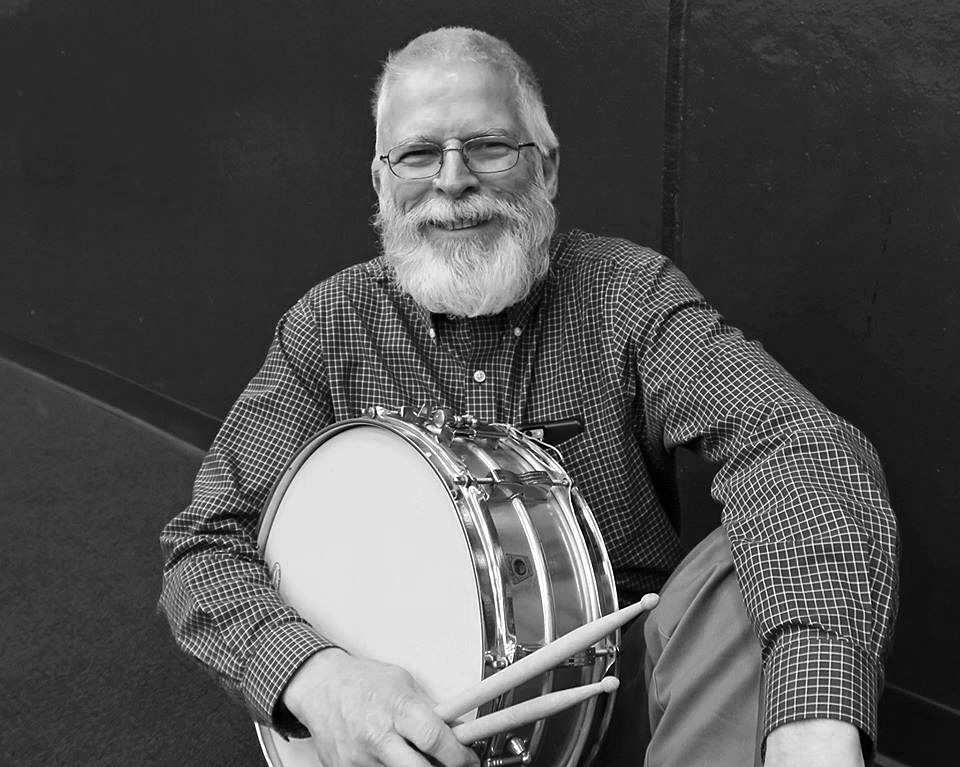
This is a portion of a letter I wrote to the staff where I used to be principal before I retired in 2020.
When I retired, I resolved to give some space between the school and me, not from lack of interest, but to give staff and administrators space to work, especially with the challenges COVID brought. From a distance I watched improvements and good work being done despite challenges.
It was gratifying to know that Alma Intermediate School was in good hands, led by a principal and assistant principal committed to the school, the staff, the students, and to learning. They also demonstrated good character qualities, work-ethic, and solid core beliefs about education.
When I received a message inviting me to mentor a student, I jumped at the chance. It’s been a privilege to come on campus each Monday morning and spend a little time with two students. Recently, we were reading a book together. When I asked if they’d like to check on progress in the garden, one of them said, “Can we keep reading while we walk?” And so, the three of us read our way down the hall and as we went, I listened to the boys and the sounds of learning through the doors of classrooms as we passed by. I’ve visited many schools with AdvancEd, many good and a few not-so-good, but the environment and tone you set with students at AIS is among the best I’ve witnessed.
What teachers do is difficult! The mental work and preparation are understood by very few. Sometimes, people who make decisions that impact the school don’t comprehend the complexities of what you do. The longer I was in education, the more vocal l became about telling political influencers what schools need.
You’re a smart staff and I’d encourage you to use your individual and collective voices to express what is needed. This even extends to state legislators. When they hear from actual teachers, many of them will listen.
Leadership sometimes involves conflict and being the recipient of unwarranted criticism or anger. Leadership can also be rewarding when you see students and teachers learning and growing. Based on what I’ve seen, AIS students and teachers are learning and growing! Are there challenges? You bet. Especially after COVID, and when you’re implementing new curriculum and probably dealing with yet another round of new assessments.
A great educator recently reminded me of “implementation dip.” That’s something we all experience when learning something new. I even experience it when learning something on drums or guitar. It’s uncomfortable, but it’s where learning happens.
Educators now face greater challenges from legislation and community expectations than I’ve ever known. To complicate things, social media provides a platform for everyone to pontificate and spread half-truths or lies within seconds.
On social media posts and in some public meetings, we get rumors and half-truths. Accurate information rarely comes in the form of a rumor or a keyboard click. It requires gathering pieces of accurate information so that decisions affecting students and staff are made carefully.
I’m thankful for those who are willing to work in our schools. They should have our support, adequate funding, and professional respect.

Thoughts on School Safety

I’ve written way too many words, but sometimes I have to write to think. Below are some thoughts I’ve had while learning about the Uvalde, TX, school shooting. I’m not interested in debate but share this for anyone interested in a recently retired school principal’s thoughts.
After teaching music ten years (and loving it), I became a school principal (and loved it). I took some pride in the fact that learning was usually at the center of my thinking though school safety did sometimes compete with my thoughts which was reasonable since kids learn better in a safe environment.
During the later years of my career, the focus on safety had to increase. In our district, all staff went through ALICE Intruder Training (excellent, and expensive), and Stop the Bleed (very good, and free to us).
Among many actions taken to improve school safety, our school had a highly qualified police officer on campus, added many surveillance cameras, and locked all entrance doors and classroom doors. When a visitor was identified on camera, office personnel unlocked the door so the visitor could enter.
Some were saddened to see these changes in school security. I was encouraged that such high priority was placed on our children in the Alma Schools. I couldn’t enter a safety deposit box vault in a local bank without passing through security and gaining access with bank personnel. Are our kids less valuable than anything found in a bank?
I used to walk the perimeter of the campus regularly, visit classrooms, and walk the hallways. I often played through scenarios in my mind, rehearsing the actions I might take if an emergency occurred. This type of thinking was unpleasant but important. On several occasions I walked the campus with parents, students, or law officers, asking them to look for safety concerns.
When I heard about the shooting in Uvalde, TX, I felt a familiar sick feeling in my chest and began familiar patterns of thought, trying to determine how different actions would have avoided loss of life. Even though I’m not a principal anymore, I tried to imagine what we might have done on our campus. Every teacher in the country probably had similar thoughts.
Mistakes were made in Uvalde, but I think most schools would fail in varying degrees in the face of someone with excessive firepower.
For Uvalde to succeed, it appears that a SWAT Team with breaching equipment would have had to be on campus to subdue the well-equipped 18-year-old shooter. It’s going to take a lot of well-equipped SWAT Teams to cover our schools nationwide…
Since this is a complex problem that defies easy solutions, maybe we should come at it from a variety of angles. Maybe we should take many careful actions to reduce risks in our schools. Maybe some of those actions would involve making it at least inconvenient for 17-21 year-olds to purchase lots of ammo and weapons. I got a learner’s permit before I could get a real driver’s license. My truck is registered and insured, as it should be.
A wise father in Alma purchased a single-shot bolt-action rifle for his son when the young man was old enough to start hunting with his dad. That young man acquired skills and good judgment in using that rifle. His dad said the boy learned to aim carefully because he had a single bullet to take down a deer. Later, when he was older, he was able to shoot other guns safely and accurately.
Some say, “Arm the teachers.” I assume they’re including the principal, secretary, custodians, cafeteria workers, bus drivers, and maintenance workers. I’ve visited with police officers about the reduction in shooting accuracy when well-trained law officers are in a stressful situation. Imagine an educator with limited training using the gun and a few bullets issued as part of her limited teaching supplies to confront someone with a superior weapon and a backpack full of high-capacity clips. Might make some of us feel better to “arm the teachers” but it would be very expensive and have little if any positive effect.
The SROs and professional crisis trainers I worked with during the last few years all said that in a perfect scenario, students would move quickly away from a threat, leaving the bad guy alone with the SRO as the only two armed humans in the school. I’d bet my life on the well-trained SRO, but the outcome of even the best judgment and actions is unknown.
 Principal Notes