Home » 2014 (Page 2)
Yearly Archives: 2014
Cliches of Teaching Still Relevant

Cliches of Teaching by Elsie Warnock
My mother wrote this small book for me as a graduation gift in 1978. It still sits on my office bookshelf and I have referred to it often during my time as a teacher and then principal. I’m astonished at how relevant it has remained over the years.
I treasure this little book and have been concerned that there is no backup copy so I scanned the pages originally typed by my mother on her typewriter in 1978. You may view the text from the following link.
Cliches of Teaching by Elsie Warnock
Character Matters
Taylor called to see if he might come for a visit one weekend. He said it was so he could get to know us better. I told my wife he was wondering what type of family he might be getting mixed up with and wanted to check us out.
During his visit, we hiked a local trail and came upon a policeman who was hiking on his day off. I introduced Taylor as my younger daughter, Anna’s, boyfriend. I mentioned that he was obviously a good guy or we would have already had an “accident” on the trail. Later that day we enjoyed browsing through family photo albums while my wife and I told stories about Anna.
A few weeks later, Taylor called to see if he could drop by. That evening he asked what we thought about his asking Anna to marry him. I told him we’d be honored to have him as a son-in-law.
Visiting with my future son-in-law, I was not thinking, “What was Taylor’s GPA?” or “How did he score on the ACT?” I didn’t worry about what degree he was pursuing, though I was pleased that he was in his last semester at UCA. My first thoughts were related to character traits. I needed to know that this young man who would partner with my daughter for life had integrity, persistence, kindness, generosity, and courage.
During April and May I often respond to online reference forms for interns who’ve recently completed their degree. It pleases me when I’m able to describe a candidate as a person of good character who demonstrates positive core beliefs.
A few years ago after interviewing several teaching candidates, I called a grocery store to check references on a prospective first year teacher. After many calls, I reached the manager who described the candidate as dependable and honest. She came in early and stayed late if necessary. She was careful and trustworthy and her cash register was always right. I hired the young lady and she quickly became an outstanding teacher on our staff. I may have had other candidates equal in academic or technical skill but, I selected her because of what I learned about her work-ethic and character.

Bob Watson, Superintendent, El Dorado School District
I worked for Bob Watson, an inspiring communicator with a keen sense of humor. He did what was right even when it was unpopular to do so. I felt great confidence as a young principal working under his leadership because of his strong moral foundation. Fourteen years ago while looking at moving to Alma, I made several “reference calls” on Charles B. Dyer before making my decision. I didn’t ask about his knowledge of school finance or legislation. My questions were about his character. I learned you always knew where you stood with Mr. Dyer and that others could rely on him to do what he said he would do. He was committed to his family and coworkers. Knowing he had these qualities gave my family the confidence we needed to make this move. I am pleased to say these same characteristics are demonstrated in David Woolly who worked alongside Mr. Dyer for years before moving into the superintendent’s position. Mr. Woolly and other district level administrators are intelligent but more importantly, they are hard workers and people I can trust.
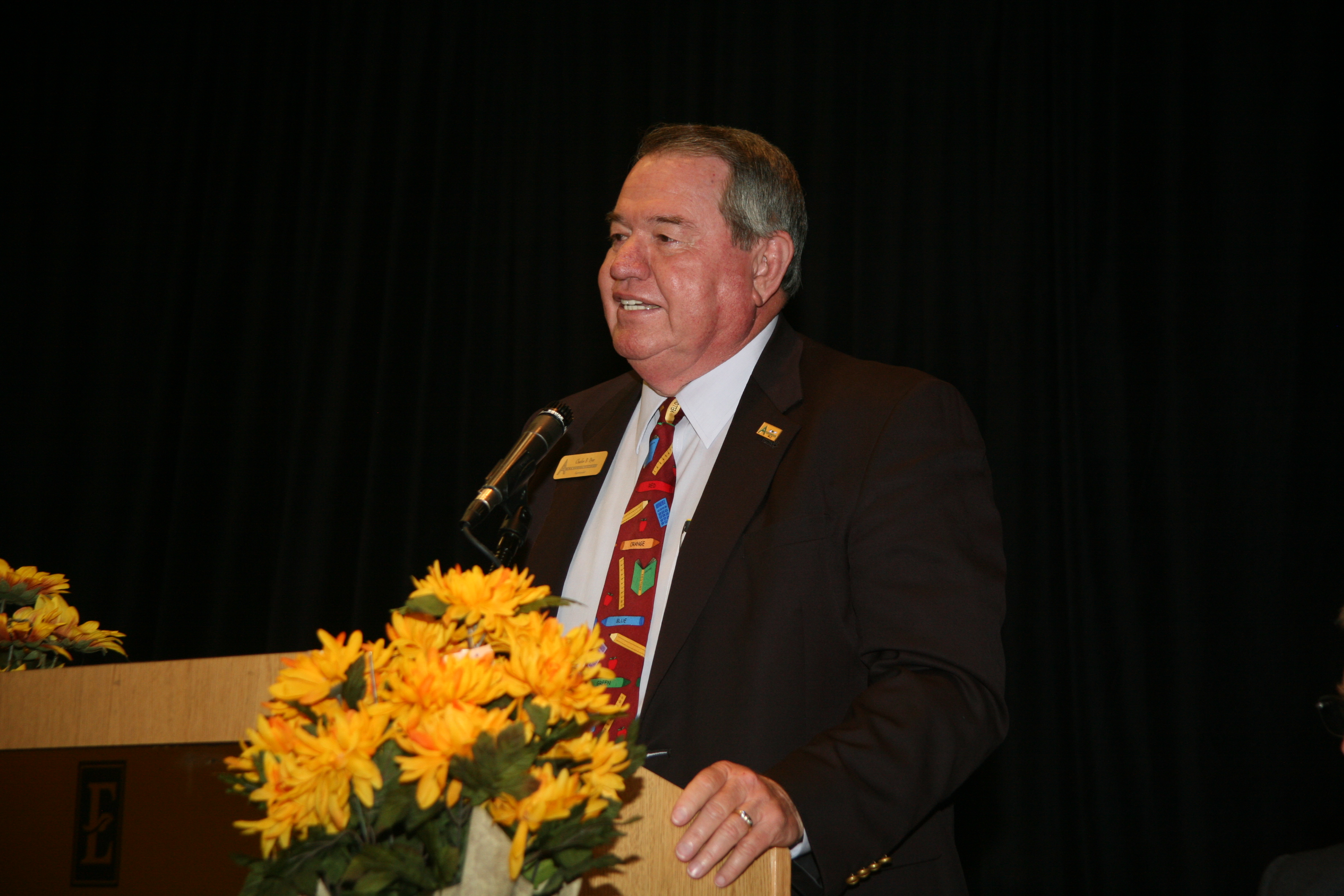
Mr. Dyer speaking to the Arkansas Association of Elementary School Principals.
As a member of the AAEA, I’ve had the privilege of working with Kellar Noggle, Tom Kimbrell, and Richard Abernathy. These leaders are all smart and great educators but, without their strong character traits, the AAEA would not have the impact it does today. They’ve shown good judgment and were astute in navigating political environments while staying focused on the needs of children and educators. The credibility of the AAEA is directly related to the integrity of these executive directors and the membership they represent.

Kellar Noggle (left) visiting with former co-workers at the AAEA Annual Conference.
Whether selecting an employee, a boss, or an organizational leader, character trumps intelligence, knowledge, and skills. When faced with a future son-in-law beginning a lifetime with your daughter, character matters more than academic achievement. When the position is one of importance and influences the happiness and success of others, character is key. As we pursue high achievement for our students, we must never lose sight of the importance of helping children become kind, generous, hardworking, and trustworthy.
Written for the June issue of the Arkansas Association of Educational Administrators newsletter.

Anna & Taylor
Alma Intermediate School Newsletter for May, 2014
Alma Intermediate School Newsletter for May, 2014
Click to open newsletter or paste the address below into search window.
Click to access News_Alma_Intermediate_0514.pdf
What Stories Will They Tell Themselves?

Fellow hiker crossing a swollen Spirits Creek. One of the two photos from a rainy day.
Day three of a backpacking trip in December was cold and wet. It was also the day I found that my old raincoat was no longer waterproof. Early that morning we crossed a swollen Sprits Creek on the Ozark Highlands Trail. I took two photos, packed my camera away in a waterproof stuff sack, and never took it out again for the rest of the day.
That day was not eventful other than that scary early morning creek crossing. We just hunkered down and walked through thirteen miles of cold and constant rain. Being a compulsive photographer, I have 40-50 pictures from every other day yet, my memories of that third day with only two photos are among my most vivid. I would later see that cold day as one of several peak experiences on that thirteen night trip.
Two later events stick out in my memory. The first was a beautiful sunny day when we climbed up the Narrows (sometimes called the “Narrs”). It was like a sidewalk in the sky with sheer bluffs on either side. Views of “skull bluff” and the Buffalo River far below were a thrill to see.

View of Skull Bluff from the “Narrs.”
On our next to the last day, we were within the last ten miles of our 180-mile trek when we realized we were off course. We like to say we weren’t lost, just confused for an hour or so. We backtracked and discovered our route with great relief because daylight was growing short. That night we camped in a beautiful cedar grove close to Collier Homestead. This experience of being “lost” and then found formed another peak experience.

Collier Homestead
On our last day, I walked slowly, not from fatigue but from a desire to make the experience last. We even added a couple of miles that were not part of our original itinerary because we wanted more time on the trail. Every step felt like a special gift. I found myself mentally planning my next trip, already excited about tackling another trail.
The memory of that pleasant last day and those earlier “peak” experiences became a lens through which I viewed the totality of that winter backpacking trip. Nobel Prize winner Daniel Kahneman describes this phenomenon as the “Peak/End Rule.” He explains that each of us has an “experiencing self” and a “remembering self.” Our “experiencing self” lives in the present. Our “remembering self” determines how we interpret experiences based on a few peak events and how the experience ends. The interpretations of our “remembering self” also influence future decisions.
With this “peak/ending rule” in mind, the month of May becomes critical in schools. We sometimes hear phrases like “winding down the year” or “coasting to the end” but these are destructive approaches. These last weeks have a strong impact on how our students remember the totality of this school year and future decisions about learning.
I have very clear memories of my worst teacher. The “peak” experiences in her classroom were periodic emotional outbursts and strong negative messages. There were no community building rituals or end-of-year celebrations. Fortunately her negative impact was somewhat mitigated by good teachers. My fourth grade teacher, Ms. Break, supplied memorable “peak” experiences as she performed oral readings for our class or connected with us as individuals when coaching us on schoolwork. While she had a stern streak, I have only fond memories of her. Years later as an adult, I would greet Ms. Break as if I were still in elementary school, so excited to see my teacher. I remember fourth grade as a good year.

Ms. Break, fourth grade teacher
Daniel Kahneman says, “The remembering self is a storyteller. And that really starts with a basic response of our memories – it starts immediately. Our memory tells us stories, that is, what we get to keep from our experiences is a story.” Look for opportunities to create peak and positive ending experiences so the learners in your school will tell themselves positive stories about this year. The results will be students and adults who are excited about continuing their learning this summer and into next year. Students and teachers will remember you favorably, but more importantly, you might shape future decisions about learning that will impact many lives for years to come.
Written for the May issue of the Arkansas Association of Educational Administrators’ newsletter.

Second picture from day three.
Two Ministers of Sorts
This is a short interview and song from two great thinkers. I first learned of Parker Palmer during one of my first experiences with the Arkansas Leadership Academy. His book, Courage to Teach, was available to us that week. I found myself underlining like crazy and identifying with many of Dr. Palmer’s struggles in teaching. I’ve come to think of Palmer as a minister of sorts because he challenges me to be congruent in my thinking and actions. He also challenges me to be more understanding of others, their stories, and their struggles.
I can’t remember how I learned of Carrie Newcomer’s music but suspect her name was mentioned during a talk Parker Palmer gave at a conference I attended several years ago. Carrie Newcomer writes songs that draw out the significance of everyday events. She is a minister of music for me because her lyrics instruct and sometimes have a healing effect.
Carrie Newcomer and Parker Palmer
Unlearning
Sometimes what you know can hurt you. During a wilderness first aid course I recently completed, the instructors spent a fair amount of class time debunking ineffective first aid actions and replacing them with evidence based actions and protocols. Many of my assumptions about first aid were wrong and I had a lot of unlearning to do.
The trainers had a habit of saying, “The body counts are in and that’s no longer the right way to treat that emergency.” In other words, new evidence suggests new practices. Will we learn from the evidence and change our practice or continue to do what has been shown not to work? Will the victim of an emergency be helped by our involvement or will we make things worse?
My first session in the Leadership Academy Principals’ Institute was all about unlearning. I’d entered the principalship with some misconceptions about what was important in school leadership. I was overwhelmed when faced with all that I needed to unlearn! This was a painful and sometimes embarrassing process. I describe the leader I was back then by saying, “He looked and acted like a principal. Folks liked him and he cared about the kids but he wasn’t anywhere close to being what the teachers and students needed.” This was hard to admit, but that admission was necessary before growth and new learning could occur.
In last month’s AAEA newsletter, Dr. Abernathy challenged us to think outside of the box and apply for waivers to enable us to implement new and different approaches to helping our students. He challenged us to look at barriers to innovation and apply to have those barriers removed.
As I began to work with teachers on this I found that I needed to unlearn ways of thinking that have become automatic over the last few years. We’ve always said, “We can’t consider looping classes from fourth to fifth grade because of certification issues.” But now the question to ask is, “Why not?” It took effort to suspend judgment long enough to let an idea float for a moment without moving immediately to constraints of present rules, time, or money. As we worked together, we found several innovations that didn’t even require waivers. Thinking in terms of “what if” and “why not” allowed those ideas to present themselves and we look forward to continuing this process.
A great educational leader speaking to our staff a couple of years ago said, “You would be appalled to learn how some children are treated right here in our own state.” Part of what he meant was that some adults who should care the most about children are harsh and cruel in their interactions. He was also referring to poor treatment in the form of ineffective instruction. Evidence has shown that certain teaching methods are ineffective yet we often see these practices continuing. Being stuck in a classroom under an ineffective teacher is the ultimate in cruelty. If the “body counts” are in and the evidence shows that a practice is ineffective, it’s time to make a change!
Changing what we do with students at the point of delivery in the classroom is difficult. Changing teaching practices requires a willingness to unlearn and a deliberate effort to do something in a new way. There will be costs in time, money, and emotions, but the rewards for persistence are great.

When we’re moving toward more effective practices and feel pushback, we must be relentless and keep plugging away. We can work with early adopters and the big middle of our staff to move forward, giving resistors limited attention. If we provide the conditions for change and allow teachers to gain the necessary learning, we’ll reach a tipping point and see acceleration in positive change.
During classroom walkthroughs recently, I enjoyed seeing the results of a challenging change we made in teaching practices over the last four years. If I tried to take teachers back to their previous ways of instruction in this area, they’d run me out of the building, and rightly so. I realized that the change was real and now part of how we do things. Making this change was hard but seeing the benefits to children and adults is rewarding.

When we feel resistance to change, we must ensure that we’re doing the work needed to support that change but, we must not fall into the trap of believing all change must be slow and incremental. Sometimes we must have the courage to say, “ENOUGH! The body counts are in. We’re stopping this practice and beginning to do that practice instead. It’s time to unlearn, relearn, and change!”
Written for the April issue of the Arkansas Association of Educational Administrators newsletter
A Few Things My Parents Didn’t Do… (A note to my parents on their 63rd Anniversary)

Jimmy & Elsie Warnock celebrate 63 years of marriage on March 10th.
There are a number of things you never did….and for these I’m thankful.
You never argued in my presence. If you had disagreements, I never knew because you resolved things in private and presented a unified front as parents. Two parents on the same page is a force to be reckoned with and simplified my younger years.
You didn’t speak critically of each other. You had a genuine appreciation for each other’s talents and skills.
You never struck me out of anger. Oh, there were a few spankings along the way, but the carefully thought out discussion in preparation for a spanking was where the real teaching occurred.
You didn’t yell at me in a harsh way. You spoke to each other and to your children in a respectful tone, even when you were disappointed or upset.
You never discouraged me. You tended to encourage my interests even when you might have liked to shape them in another direction. Sorry about the drum related headaches.
You never dropped me off at a school music performance and picked me up later. You stayed and watched the performance. Any criticism was mild. “Why did the drummers keep talking during the performance?” Your message to stop talking was received.
You never acted as if you were sacrificing anything for us even though you were. I remember daddy’s early morning departures for work and years of shift work so he could provide for our family. I remember mother grading tests and spending time reading to prepare as a teacher.
You never lost commitment for each other. I remember hearing your late night conversations and knowing that you were committed for the long haul.

My father writing a letter to my mother in the early 1950s from Korea.
You never fail to recognize each other’s strengths. I remember daddy saying on several occasions, “It’s amazing what your mother can do.” I remember mother bragging on and thanking daddy for the work he did.
You didn’t make unreasonable demands on each other or your children. You depend on each other in a healthy way. This has become even more pronounced during recent years. You both confirm that the other has strengths that complete you and make it possible for you to continue to thrive as you do.
You never worried about having the “best” of everything. You taught me it is what you do with what you have that matters. Used or secondhand is just fine if it works. Note to Daddy: One exception I take to this lesson relates to lawn mowers. After spending so many Saturdays of my childhood watching you patch up mowers rather than mowing, I now own a very nice mower.
You never belittled what I said even when I was a know-it-all teenager. You listened even when you probably wanted to show me the irrationality of what I was saying.
You never tried to “go it alone” in life. You built friendships through your work, church, and your community. You tended to hang around other good people, sharing your strengths and learning from them. You made everything you were involved in better.
You didn’t criticize my wife. You treated her like a daughter and accepted her as a true member of your family.
You never rejected friends or family. You were understanding and showed love for others even when they made mistakes or seemed distant for a time. You’ve shown a tendency to forgive and move on with others.
To be continued….
Congratulations on sixty-three years together. That is an amazing accomplishment. I’ve been around to see fifty-eight of those years and have some credibility on the subject of your marriage and your parenting. I give you highest grades on both areas.
Thank you for your continuing commitment to each other, your family, church, and community. We are all blessed by your influence.

Jimmy & Elsie Warnock around 1953
 Principal Notes